

Conventional server management causes businesses to pay for unused capabilities and hinders engineering energy from product development. Using physical or virtual server architecture typically results in operational bottlenecks and reduces scalability.
Aqlix promotes Serverless Architecture where the cloud provider manages execution infrastructure, allowing businesses to concentrate on functionality. This architecture provides unlimited scalability, reduced operational burden, and a pay-for-value pricing model so that organizations can innovate at scale while managing costs.
Why Serverless is a Business Game-Changer
The Impact of Serverless Computing in Cloud Architecture for Businesses By decoupling infrastructure management, businesses will be able to deliver more value—and enjoy lower costs, greater agility and scale.
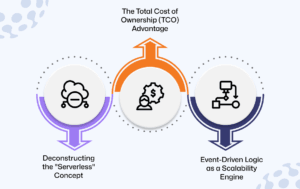
1. Deconstructing the “Serverless” Concept
Even with the name, serverless applications still have servers. The primary difference is server management is abstracted. These developers push code without the concern of managing infrastructure, and they bill per execution time and amounts used by resources only. This approach allows to control the cost down to the very dollar and completely remove server idle costs while teams can focus on application logic.
2. The Total Cost of Ownership (TCO) Advantage
Serverless reduces operational costs significantly. No worries about server maintenance, patching or peak capacity. This pay-per-use model ensures better return-on-investment (ROI) for cloud infrastructure by charging businesses only when code is run. Serverless models transform fixed IT costs into scalable and consumption-based expenditures, paying only for usage in line with actual business demand or performance.
3. Event-Driven Logic as a Scalability Engine
Serverless Architecture with Event-Driven Computing: An application built using serverless architecture will function on events that provide the trigger to run a backend application written in Serverless architecture. It allows apps to scale automatically from zero users to thousands of users with no manual intervention, thereby ensuring high availability and optimal performance during sudden spikes in traffic.
Measuring Success and Avoiding Cloud Pitfalls
This prevents wasted expense and load ground issues. Data, including analytics, billing insights, and multi-cloud strategies help to realize serverless benefits.
1. Monitoring ROI through Real-Time Granular Billing
Serverless billing is transparent, charging you based on either per-function execution or API calls. You can find out where you are spending most of the money for your workflows, optimize their use, and predict precisely how much will be spent on cloud computing. This granular view not only improves budgeting but also aids strategic decisions for future digital transformation efforts. Reduced system performance and excessive interdependencies between apps can lead to poor user experience, creating silos in the enterprise and morphing into a lack of agility.
2. Navigating Vendor Lock-in and Architectural Complexity
Single-cloud provider reliance adds lock-in risks. Businesses can create portabal serverless strategies using Aqlix, it integrates multi-cloud or hybrid approaches as well. This decouples applications from vendor-specific aspects, allowing them to be built with scalable and maintainable growth patterns in mind.
Transitioning to a Serverless Workflow
Moving to serverless comes with a lot of planning and often some gluing together of functions, storage, and databases. This is to safeguard against disruptions whilst leveraging efficiencies through a structured transition.
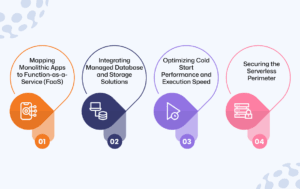
1. Mapping Monolithic Apps to Function-as-a-Service (FaaS)
By utilizing a FaaS platform, such as AWS Lambda or Azure Functions, large applications can be sharded into microservices or discrete functions. By decomposing, agility improves, updates are simplified and downtime is reduced. Larger, independently deployable functions also improve collaboration between development teams.
2. Integrating Managed Database and Storage Solutions
Serving serverless functions combined with managed services such as DynamoDB, S3, or other solution stores creates a fully serverless backend. Managed databases are self-scaling, alleviate administrative overhead and blend seamlessly into event-driven functions as a service to allow fluid data flow for high-performance applications.
3. Optimizing Cold Start Performance and Execution Speed
When invoked infrequently, serverless functions can suffer from “cold starts.” The code optimization, minimizing the size of the packages, and the pre-warming of functions tends to enhance response time. AI monitoring tools can also learn usage patterns, preload those functions to keep them instantly ready for execution, and deliver a fast and consistent user experience.
4. Securing the Serverless Perimeter
However, serverless environments require well-defined and robust security strategies. This includes defining fine-grained IAM roles and policies, API gateways, and access control to protect various functions and data. Automating serverless applications security with automated monitoring and ML-powered threat detection allows you to continually test decentralized and event driven workloads.
Conclusion
Serverless architecture is not just a technical decision; it represents a shift in strategy that connects IT spending to business. This allows organizations to concentrate on innovation. scaling and offering a better customer experience by removing the need to manage infrastructure.
Aqlix IT Solutions enables enterprises to adopt serverless functional ecosystems, improving cloud migration, AI-powered workflows and backend development. Optimize your architecture and enable a cost-effective, agile enterprise that has clear business metrics with Aqlix.
Frequently Asked Questions
What is serverless architecture, and how does it work?
Serverless architecture enables developers to deploy by just putting up the code and not managing servers. All infrastructure, scaling and execution logic are managed by the provider. It is a cost-saving option because billing takes place based on actual utilization. Functions react to events or triggers, scaling automatically for high throughput without manual server maintenance.
How does serverless reduce operational costs?
Serverless removes costs of idle servers, maintenance, and patching. Organizations only pay for executed code and consumed resources converting fixed IT costs to scalable, usage-based expenses. This minimizes overhead and better aligns the ROI of cloud investments, enabling more effective and predictable resource allocation.
Can legacy applications be moved to a serverless model?
Yes. Using Function-as-a-Service (FaaS) platforms, legacy or monolithic applications can be decomposed into microservices or discrete functions. Serving as an enabler of agility, the transition to microservices allows for independent deployment, and shifts towards event driven execution for performance that is scalable and resilient without a large rewrite.
How is serverless architecture secured?
Serverless security is based on fine-grained IAM roles, API gateways and access control policies. Decentralized functions are protected from attack by monitoring tools and ML-based threat detection. Analyzing security best practices like strong authentication, encryption, and constant audit becomes imperative for a robust defense against serverless abuse.
What are common pitfalls when adopting serverless architecture?
Pitfalls may be cold-start latency, vendor lock-in and misconfigured event triggers. Dependency management can be complex for businesses, too. Aqlix knows cloud as well as AI-powered monitoring, making these risks manageable and ensuring optimal performance and elasticity throughout serverless deployments with cost-efficacy.