

Keeping customers is far less expensive than bringing them in, yet most organizations don’t know AI-Driven analytics someone is on the way out until cancellation time comes around. Reactive methods rarely fight churn, resulting in wasted revenue and strained customer relations.
AI analytics allows companies to predict that they will lose customers weeks before the churn actually happens. In this way, businesses can create predictive models based on behavioral data and set up retention workflows proactively. For companies that adopt this technology, it translates to better customer insight through enhanced pattern recognition, optimized intervention tactics (to avoid attrition) and ultimately improved lifetime value and operational efficiency.
The Mechanics of Predictive Retention
Predictive retention employs data analysis, machine learning, and behavioral analytics to forecast customer churn. By catching trends early, firms can preempt them before they develop into problems. AI-enabled analytics assist enterprises in spotting the signals amid all the noise and converting them into actionable user workflows that foster continued engagement and loyalty.
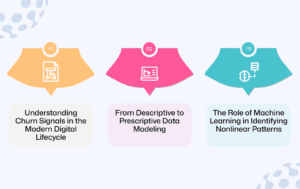
1. Understanding Churn Signals in the Modern Digital Lifecycle
But customers show subtle signs before they churn: Whether it’s less regular logins to the platform, decreased usage of a particular feature, or lost engagement with your communications. AI models comb through an array of channels, from app activity to support interactions, for those signals. Identifying telltale signs means targeted campaigns or support can be offered, increasing the likelihood of retaining that revenue.
2. From Descriptive to Prescriptive Data Modeling
Conventional analytics tell you what happened but don’t pinpoint next steps. Prescriptive AI analytics tells us which customers are at risk and advises on specific retention measures to take. For instance, it can provide tailored offers or targeted communication based on behavioral patterns. This evolution makes it feasible to turn insights into strategic moves that drive efficient churn prevention.
3. The Role of Machine Learning in Identifying Nonlinear Patterns
Manual analysis struggles to identify complex, non-linear patterns of customer behavior. Machine learning algorithms consider many variables at the same time, unearthing hidden correlations. Enterprises can model these relationships to predict churn, allowing interventions that are more accurate and timely, better enabling resource allocation for retention efforts.
Maximizing Precision and Long-Term Value
Models that are continually validated, integrated across teams and calibrated for shifting customer behavior are at the heart of successful predictive analytics. In this way you ensure value for the long term, higher retention rates, and a measurable ROI.
1. Validating Accuracy Through Back-Testing and A/B Trials
Regular tests ensure that AI predictions are in reality. A/B trials for controlled populations and back-testing on historical data can provide measures of accuracy as well as forecast revenues attributable to interventions. Ongoing validation fine-tunes precision and builds confidence in retention strategies that indicate future group performance.
2. Overcoming Data Silos and Implementation Barriers
Having data in silos within departments may limit prediction accuracy. In this article, we explain how adopting this technology will hinge on bridging systems with AI and aligning teams to a data-driven culture. Organizational readiness leading to outcome adoption offers actionability through predictive analytics tools.
Building a Robust Churn Prediction Pipeline
And creating a functional churn predictor system implies structured data workflows, real-time analytics and integration into operational platforms. Designing a strong pipeline ensures that actionable, predictive insights are in line with business goals.
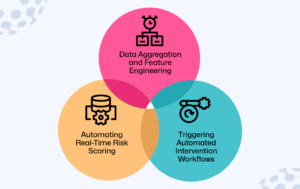
1. Data Aggregation and Feature Engineering
A dataset that brings together data from CRM systems, support tickets, purchase history and usage logs. Feature engineering to extract relevant signals like frequency, recency and engagement metrics. Training machine learning models that can predict reliably and accurately churn so as to optimize retention strategies assumes clean, structured data.
2. Automating Real-Time Risk Scoring
AI models can allocate a live churn probability score to each and every customer. Dashboards plot risk scores in real time so that teams can focus on accounts with a high level of risk. Automating this rating minimizes manual scanning of customers, gives continuous visibility into the success scores, and helps proactively engage customers before reaching resurrection.
3. Triggering Automated Intervention Workflows
AI insights can trigger timely interventions with integration to marketing automation and CRM systems. For example, on the basis of risk scores personalized offers, retention emails, and triggered kind reminder stuff. Such automated workflows also allow for greater responsiveness, save manual effort, and improve retention program effectiveness.
Conclusion
AI-powered predictive analytics allow you to make customer retention a data-driven, proactive effort. When at-risk customers are detected early, companies can connect with these users through tailored intervention that ultimately leads to increased loyalty and a decrease in revenue loss per churned customer not to mention higher lifetime value.
Aqlix IT Solutions helps enterprises build and deploy an AI analytics engine that retrieves actionable insights from raw behavioral data. Through Aqlix, businesses are able to predict their churn, keep their customers and optimize for growth.
Frequently Asked Questions
What is AI-driven churn prediction?
We can utilize machine learning algorithms to analyze customer behavior and predict possible churn through AI-powered churn prediction. By detecting patterns of usage, engagement and support within users, businesses can identify when customers are at risk for churn early on in the process through retention strategies.
How does predictive analytics reduce customer attrition?
Predictive analytics converts raw behavioral data into real-time insights. Companies can prioritize their interventions, automate retention workflows, and personalize communication. By moving before customers churn, organizations can reduce churn and build longer-lasting relationships.
What role does machine learning play in customer retention?
With humans being known to miss direct relationships, machine learning can discover complex and non-linear connections between customer behaviors. Algorithms can be employed to pick up on early warning signals, predict churn risk, and optimize targets for intervention, allowing an enterprise to target its retention efforts on high-value customers.
How do automated workflows improve retention?
Whenever the AI states that a customer is high risk, automated workflows trigger timely interventions to upscale email promotions or special offers, or even execute retention calls. This also speeds up responses, reduces manual efforts, and increases customer engagement and satisfaction.
Can predictive churn models integrate with existing CRM systems?
Yes. Similarly, AI-powered churn prediction tools are able to integrate with a CRM platform, so they can access customer data and compute real-time scoring to intervene. It acts as a common system for predictive insights across sales, marketing and support teams so you can take proactive retention actions consistently.