

Legacy systems still run the core of operations at many companies. But legacy buildings, increased maintenance fees and lack of integration stand in the way. A well-defined legacy system modernization path enables businesses to move from outdated infrastructure to scalable, robust, and future-proof solutions that won’t disrupt ongoing operations.
Organizations with modernization strategies achieve enhanced operational efficiency, higher-performing systems, and more alignment with digital transformation objectives. This blog provides a pragmatic guide to how CIOs can modernize their legacy systems, reducing risk and increasing benefit in the long term.
Enterprise Challenges With Legacy Systems
Traditional infrastructures often hinder new ideas and business as usual agility. Technical debt builds, and upgrades become more difficult and expensive. Enterprises need to be aware of these limitations if they are considering modernization initiatives.
A modular plan of action guarantees that modernization meets business goals and keeps your operations running. The following are some important obstacles that businesses encounter when dealing with legacy systems.
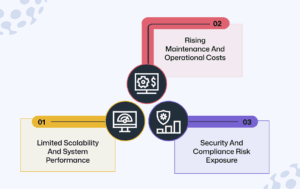
1. Limited Scalability And System Performance
Many of these legacy systems were designed for older business models and smaller workloads. As organizations grow, these systems become challenged to manage more data and provide a high-quality service to users. Monolithic designs are generally inflexible, with scaling being difficult and expensive.
Low processing speeds, periods of inactivity, and lack of interoperability lead to slowdowns on the business level. Modernization adds microservice, cloud, and container capabilities, which enhance the performance and scale.
2. Rising Maintenance And Operational Costs
Legacy systems often demand expertise in esoteric skills and dead-end technologies. After years, the cost of maintenance exceeds system output. Enterprises have growing infrastructure costs, patch management difficulties, and hardware reliance.
Technical debt compounds these issues. IT results in repeated workarounds that suck up IT resources, taking the focus away from innovation. A modernization plan lowers the lifetime cost of operation by removing extremely inefficient systems and replacing them with some that are optimal.
3. Security And Compliance Risk Exposure
Legacy applications cannot keep up with new security guidelines or mandates on compliance policies. Poor encryption, minimal access controls and outdated software make it vulnerable to e-threats.
While other businesses that work within regulated industries have added compliance concerns. With modernization, enterprises can move to a zero-trust security model, automate monitoring of sensitive data and secure API integrations.
Executing Enterprise Modernization Roadmap
A pragmatic plan and a phased approach is pivotal to drive the roadmap of legacy modernization. Organizations need to juggle technical evolution with business as usual so as not to put themselves at risk of operational shock.
With an incremental path towards modernization, companies can particularly update their technology at a pace that limits many of the risks involved.
1. Phased Implementation And Risk Mitigation
Step-by-step upgrades minimize the downtime and service interruptions. Enterprises don’t have to throw the entire system away all at once, but they can modernize particular modules or services as time goes on.
This staged approach enables teams to test changes, track performance and mitigate any issues in the early stages. It also makes sure that your mission-critical systems stay up and running as you make the move. Risk analysis and impact evaluation are mandatory in each phase.
2. Integrating Modern Platforms And Tools
Any modernization exercise may include cloud platforms, APIs and microservices architectures. Cloud-native systems provide flexibility and cost-effectiveness, and the interoperation of systems has been enhanced by APIs.
Businesses can leverage automation, machine-learning algorithms, and AI-based analytics to improve operational decision-making. Smart chatbots and predictive ML systems assist in customer service, data analysis and do not generate more manual work to be done.
Organizations considering AI-driven capabilities can integrate modernization initiatives with broader transformation objectives, such as advanced analytics and automation strategies.
3. Data Migration And System Continuity
Data Migration is an important aspect of enterprise modernization initiatives. The safe and error-free transmission of data guarantees a smoothly running business and compliance.
Best practices before migrating Data cleansing and validation testing should be performed Implementing backup solutions prior to migration Enterprises also need to roll back strategies for unforeseen complications.
Parallel processes in the transition maintain continuity of care. Proper forethought prevents data loss and maintains your services in a healthy state.
Optimizing Modernization For Long-Term Value
Modernization does not happen just once. Continued tuning and governance is necessary to maintain the performance and scalability of a system.
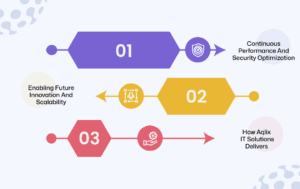
1. Continuous Performance And Security Optimization
Monitoring during post-modernization improves system efficiency. With real-time analytics and automated alerts, you will identify trouble before it becomes a major problem.
Organizations need to be vigilant and constantly assess and optimize the value of their modernized infrastructure over time.
2. Enabling Future Innovation And Scalability
Modernized systems to establish an environment conducive to innovation. Interoperable Systems. Interoperability facilitates the application of new ideas across a range of technologies. Machine-learning algorithms, predictive analytics, and automation workflows can be built with no structural barriers for enterprises.
Highly scalable and available backend for fast feature roll-out enhanced user experience. Embedded with cutting-edge technology, it drives digital transformation across the enterprise.
Companies that combine modernization with an AI strategy can gain deeper insights and automation possibilities.
3. How Aqlix IT Solutions Delivers
Aqlix IT Solutions helps companies to cover complex modernization journeys. Focusing on scalable architecture, secure integration and operational continuity, Aqlix is about guiding companies from the old world to the new.
It helps the organization to tie modernization directly to business imperatives resulting in measurable performance improvements and sustainable growth. Leveraging technical prowess along with strategic planning, Aqlix helps organizations to deleverage their tech debt and boost their digital muscle.
Conclusion
A solid plan for legacy system modernization will enable companies to address scalability constraints, ever-increasing maintenance fees and security risks. With phased rollout, safe data migration and sustained optimization, businesses can modernize without compromise.
Strategic upgrading is the backbone of innovation, automation, and long-term resilience. With efficient and expert consulting from Aqlix IT Solutions, organizations can break up with outdated systems for an industrially scalable platform for digital growth.
Frequently Asked Questions
What is a legacy system modernization roadmap?
A legacy system modernization roadmap is a work package that defines the methodology by which an organization migrates its legacy information systems to modern platforms. It involves an assessment, phased adoption, data migration and risk mitigation and continuous optimization to guarantee scalability, security and business continuity.
Why is phased modernization important for enterprises?
Staged modernization mitigates operational risk by replacing little bits of the infrastructure at a time. This method permits businesses to verify results, govern the dependency, and reduce service disruption without halting core business operations as they migrate.
How does modernization improve enterprise security?
Modernization gets rid of older security systems and replaces them with advanced equivalents, including zero-trust architecture, automation-based monitoring and encryption schemes. These dimensions of control help enforce regulatory compliance, minimizes attack surfaces, and safeguard sensitive enterprise data against new cyber threats.
Can legacy modernization support AI and automation initiatives?
Yes. New age systems offer the scalable infrastructure and API integrations that AI, machine learning, and automation need. This means businesses can scale out use of predictive analytics, intelligent chatbots and data-enabled decisioning tools easier.
How long does enterprise legacy modernization take?
The schedule will vary by the complexity of your system, any dependencies, and what you need for your business. While full modernization is taken across a longer strategic timespan, phased approaches often enable organizations to see incremental improvements after just a few months.