

Legacy systems are often a vital cog in enterprise operations, but obsolete infrastructure can restrict innovation, drive up costs and limit scale. It is essential that these systems are modernized, but organizations often struggle with legacy modernization projects. By learning from the experiences of peers, companies can effectively plan, mitigate risk and derive tangible operational benefits.
At Aqlix, we enable organizations to transform their legacy systems with AI development, machine learning and custom software solutions. Our methodology is centered on strategic compatibility, efficient operations and scalable transformation for long-term performance-based growth.
Why Legacy Modernization Projects Fail and Common Mistakes
Legacy modernization programs often fail because of technical and strategic errors in judgment. By acknowledging these hurdles, projects can be carried out with a high level of efficiency and value.
Modernization isn’t something you do just by updating technology- it demands well-done preparation, a map to guide the way, and alignment with the business goals. Not accounting for all of these elements may result in expensive delays, security exposures, or uninspiring business results.
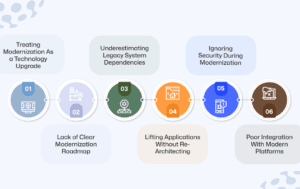
1. Treating Modernization As a Technology Upgrade
Treating modernization as a technical refresh only typically doesn’t end well. Irrespective of operational objectives, better customer experience and being more agile as a business can also fail to deliver value from new investments in platforms.
Modernization must improve the way you work, save money, and foster innovation.” Technology is not enough to lead the transformation; strategy and alignment are fundamental.
2. Lack of Clear Modernization Roadmap
Modernization with no goals and proof of success adds risk to the project. Lack of clarity around scope, priorities, and dependencies can lead to late deliveries, budget blowouts, and lack of adoption.
Developing a detailed plan with specific objectives that stakeholders can support is the best way to make sure they know what you expect them to do and within which time frame, as well as how the change will impact this business.
3. Underestimating Legacy System Dependencies
In immature systems, some of the interdependencies are explicit, and some may be hidden as they lie in outdated architectures, connected modules, or complex data flows. Failing to account for these dependencies could lead to unplanned outages, partial integration, and business disruption.
A comprehensive review of system architecture and integrations is imperative to avoid downtime during the upgrade.
4. Lifting Applications Without Re-Architecting
Modernization, through “lift-and-shift,” involves simply moving applications to new infrastructure without redesigning them. While this can accelerate deployment, it seldom contributes significantly to scalability, performance or flexibility.
Re-architecting apps means modernization becomes an opportunity to operate more effectively and adapt to new business requirements—it’s a source of value that has legs.
5. Ignoring Security During Modernization
It keeps old security models in place that allow modernized systems to fall out of mandated assurance and susceptibility, cybersecurity, and data breach laws and rules. Current secure measures such as identity management, encryption, and access control are necessary to safeguard sensitive information.
Security needs to be part of modernization plans so that risk is addressed along with system improvements.
6. Poor Integration With Modern Platforms
Poorly designed APIs, or a lack of integration, prevent the full benefits of modernization from being derived. Without integration between ERP, CRM, and operational systems, companies can overlook opportunities for automation, analytics, or efficiency benefits.
API-led modernization means apps can talk to contemporary tools and platforms in a way that’s harmonious with business.
Strategic And Operational Modernization Errors
In addition to technical gaffes, operational and strategic blunders frequently squander modernization ROI. By tackling these areas, you’re likely to have less friction in your adoption process and longer-term benefits.
1. Skipping Change Management And Training
Today, it’s user readiness- not just technology which is critical for successful modernization. Workers need to be trained on new systems, processes, and workflows. Avoiding change management leads to pushback, mistakes, and sluggish take-up.
Staff training and open styles of communication help staff members to integrate new technologies effectively.
2. Inadequate Testing And Rollout Planning
Without staging the testing or rolling it out in a controlled manner, modernization poses significant operational risk. Real workloads can lead to system failures or discover hidden bugs after deployment.
Incremental trials, pilot deployments, and phased rollouts are ways that companies can explore the feature with minimal disruption to business.
3. Focusing On Tools Over Outcomes
Focusing on tech first leads to little efficacy. Modernization ought to help us be more efficient and scalable and better for the customer, not a new piece of software.
Results-oriented planning guarantees that the AI/ML algorithm development and automation investments are designed to contribute directly to specific business outcomes across the entire operation.
Best Practices For Successful Modernization
A best practice strategy helps ensure successful legacy modernization and reduces risk while maximizing ROI goals.
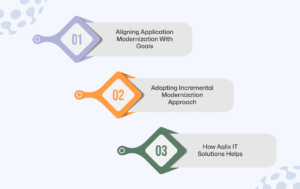
1. Aligning Application Modernization With Goals
Modernization must be conditioned by strategic goals. By aligning initiatives with business outcomes, technology investments add to overall operational efficiency and cost reduction as well as foster innovation.
This alignment also contributes to concrete KPIs, the tracking of progress, and the assessment of modernization work impacts.
2. Adopting Incremental Modernization Approach
Staged or incremental modernization lowers risk and adds flexibility. Patch critical components, then bring other modules in slowly to eliminate downtime and allow testing and user adjustment.
Step-by-step solutions also allow companies to experiment and refine strategies for subsequent phases- leading to better long-term performance.
3. How Aqlix IT Solutions Helps
Aqlix offers end-to-end legacy modernization services, undertaking AI development, custom software development, and machine learning to make the transition of your legacy systems into scalable, secure, and future-proof platforms.
Our proven methodology minimizes risk, ensures a smooth implementation, and increases visibility in your path to success.
Conclusion
Technical misses, strategic mismatches, and operational screw-ups have brought about misery in most legacy modernization initiatives. By avoiding pitfalls like equating modernization to just another tech upgrade, ignoring dependencies, or underestimating security issues, the chances of your project succeeding are dramatically higher.
By coupling modernization with business needs, taking an incremental approach and utilizing knowledgeable partners such as Aqlix IT Solutions, businesses can securely modernize applications to increase scalability in order to plan for future growth
Frequently Asked Questions
What is legacy modernization?
Legacy modernization involves transforming outdated software systems to increase scalability, performance, security, and alignment with business strategies.
Why do legacy modernization projects fail?
Many projects fail for reasons such as bad planning, lack of a clear goal, overlooked dependencies, weak integration pieces and testing, or lack of any security mechanisms.
How can incremental modernization reduce risk?
Organizations can test changes, reduce downtime, and adjust strategies before moving on to the next module or workflow by updating systems in phases.
What role does AI development play in modernization?
AI innovation modernizes legacy systems with predictive analytics, automation, intelligent decision-making, and ML-based optimization.
How can Aqlix IT Solutions support modernization?
Aqlix delivers custom software development, AI-driven solutions & scalable modernization to meet business needs in the most secure and efficient way.

