

In this age of rapid business, basing decisions on gut feeling is no longer a guarantee for success. Big Data affects every aspect of how organizations do business across a number of departments and yet critical decisions are often made on gut instinct. Experience is valuable but not enough to deal with the complexity, the scale and the speed of modernity.
Data-Driven Decision Support Systems (DSS) are changing the way businesses analyze data, develop strategies, and design products. Using analytics, machine learning and structured insights, DSS platforms enable businesses to stop guessing and start making decisions with certainty.
Aqlix is dedicated to assisting enterprises in adapting innovative technology offerings that are shaping their tomorrow and driving sustainable progression. Modern DSS platforms allow companies to stay agile and competitive through smarter decision making in any industry.
Why Gut-Based Decisions Fail
Today, organizations work in fast-paced environments, and managers need to make accurate decisions quickly. Intuition has led leaders for centuries, but using intuition alone can result in inconsistencies, risks and missed opportunities. A data-structured approach enables one to drive sound decisions based on real insights and not guesses.
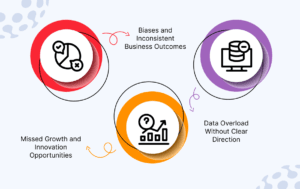
1. Biases and Inconsistent Business Outcomes
Human decision-making is clouded by individual experience, emotional affect, and cognitive bias. These are the things that make decisions that sound good but don’t have empirical backing. Unpredictable leadership decisions in product and operations can lead to mixed performance results and misplaced priorities. Such DSS grounded on data, help in the rationalization of decision making, by providing consistent information to elevate certainty and accuracy.
2. Data Overload Without Clear Direction
We collect tons of data from CRMs, ERPs, marketing tools and customer platforms. But knowledge doesn’t always lead to increased clarity. Data without analysis is like a human with no face. Decision Support Systems aggregate this data through the use of analytics engines, dashboards and AI models, enabling teams to concentrate on insights rather than drowning in raw numbers.
3. Missed Growth and Innovation Opportunities
Intuition-based decisions are often conditioned to past experiences that could misrepresent market conditions. Perhaps as consequence, businesses may miss trends, needs of customers and opportunities for innovation. Data-driven decision support systems recognize trends, forecast the future and uncover new opportunities so businesses can take proactive action to stimulate growth and long-term innovation.
Understanding Data-Driven Decision Support Systems
Decision Support Systems are fusing analytics, data processing and AI build to assist business in assessing alternatives and making rational decisions. These are systems that take raw data and turn them into insights for strategy, process improvement or product development.
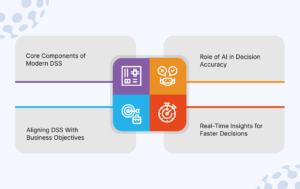
1. Core Components of Modern DSS
Contemporary DSS systems consist of several coupled elements. Sources of the data grab from business systems, while the engines process and interpret it. Dashboards collect insights in a visual interface, making it simple to understand and take action.
Machine learning models improve such systems by identifying patterns and forecasting our chances of being in luck. Collectively, these parts give an integrated context to facilitate strategic decision making for all areas.
2. Role of AI in Decision Accuracy
The development of artificial intelligence is the key to improving the accuracy of DSS platforms. Machine learning models examine patterns within historical data to identify trends and suggest actions. This in turn enables businesses to operate by real time insights, not guesses.
Thanks to AI-powered DSS, anomalies can be spotted and demand forecasted as well as resource allocation. All these features allow companies to be more agile in their response to change.
3. Aligning DSS With Business Objectives
An ideal DSS platform conforms to organizational goals. Bespoke software development creating a system that meshes with what matters most in the business Productivity Utilisation Customer Service.
The more that dashboards, data models and workflows can be customized, the better to ensure decision support tools are tailored with actionable information. This alignment enhances strategic planning as well as growth over the long time.
4. Real-Time Insights for Faster Decisions
Timing is everything in fast-paced sectors. It is the processing of data as soon as it arrives and making it available to the DSS platform so that its users can use such insights instantly accelerating the decision process. This is particularly beneficial in sales, logistics and customer service.
With timely data available, teams are able to react faster to problems and opportunities. Dashboards in real-time create transparency in performance metrics and support leaders with timely, informed decisions.
Building Custom Data-Driven DSS Solutions
A useful DSS must be planned, integrated, and constructed suitably. Shelf software may contain simple analytics, and a proprietary client ensures the system is tailored to individual business requirements and can be well-integrated into existing systems. Enterprises adopting customized DSS offerings are able to achieve greater data mastery, visibility and strategic alignment.
1. Identifying High-Impact Decision Areas
The beginning steps of a DSS are to understand where the best possible decisions can bring the most value. This could be product planning, sales forecasting, understanding customer behavior or improving operations. Key into high impact areas Companies adopt DSS to derive or maximize benefits hence, seeking measures that have the greatest value and impact allows for quantifiable results.
2. Integrating Data Sources Seamlessly
A DSS is useless if it doesn’t have good data. Build data applications that pull from a wide range of sources, whether it be an internal system or cloud tool and even external databases. This holistic integration delivers timely, relevant information directly to decision-makers and eliminates silos that create blind spots.
3. Designing Actionable Dashboards and Models
Intuitive dashboards are crucial to the success of DSS. Visualizations are clear enough that teams can understand insights and respond quickly. For different departments, custom dashboards may include key metrics, trends and predictive insights. Dashboards are augmented with AI-based models that provide nudges and predictions, thus accelerating decisions and improving confidence.
Conclusion
Moving from instinct-based to data-driven decision-making represents an enormous transformation in how companies are run. By utilizing AI development and custom software development, decision support systems enable businesses to continue simplifying sorting through complex data, enhancing the accuracy of decisions made, and allowing for faster development of products.
Companies that implement DSS platforms can mitigate uncertainty, make quicker adjustments to their markets, and find new paths for growth. Aqlix facilitates this transformation by providing organizations with intelligent technology solutions to empower decision-making and fuel growth through innovation.
Frequently Asked Questions
What is a data-driven Decision Support System?
A data-driven Decision Support System is a system that collects, processes and analyzes business data to support its leader in taking decisions. It offers an analytics and AI platform, which adds value to data for organizations.
How does AI improve decision accuracy in DSS?
Artifical intelligence makes DSS smarter, just like pattern finding, trend predicting and offering suggestions based on the knowledge of the past and real time. AI models can constantly learn and get better, so the agency can make faster and more accurate decision while using less assumption.
Why is custom software development important for DSS?
Custom development helps ensure that a DSS is adapted to an organizations’ objects, workflows and sources of data. It enables better integration, greater scalability and more valuable insights than generic tools that do not reflect the needs of a company.
Which business areas benefit most from DSS implementation?
Decisions Support Systems are useful in different fields such as product development, sales forecasts, operational planning, marketing actions or customer service. By making better decisions in these areas, companies can optimize efficiency, minimize risks and drive long-term growth.