

With more businesses shifting to cloud-based solutions, Software as a Service is the foundation of modern business processes. Companies throughout the demand planning and sales/marketing space have emerged as suppliers of these applications for customer relationship management (CRM) and other business-critical functions to financial applications. While this transition has made information more readily available and processes faster, it has also posed very real questions of data privacy.
Modern companies now have vast amounts of sensitive data within SaaS applications. These solutions often involve the development and use of AI, machine learning and integrated services to optimize performance. But such greater dependence on digital infrastructure also introduces a set of new threats, namely unauthorized access, data abuse, and compliance exposure.
SaaS application data privacy concerns are key issues that companies must address in order to secure their information and maintain customer confidence. With thoughtful planning and adoption of the proper technology preparation, organizations can mitigate risk and construct secure privacy-first systems.
Growing Data Privacy Risks
As SaaS becomes more popular, the amount of sensitive information held in cloud-based environments also grows. This makes privacy safeguards a paramount issue for organizations of any size. SaaS-platform businesses are typically going to want to understand how they have their data collected, stored, managed and accessed.
In the digital era, where there is a tremendous emphasis in transforming everything into bits and bytes, there are also new possibilities for innovation but also newer challenges in preserving privacy. Businesses need to be aware of the risks and take steps to protect their data today and into the future.
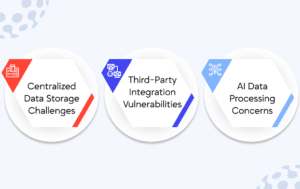
1. Centralized Data Storage Challenges
Cloud-SaaS is often served centralized, so a cloud stores a large dataset. This information accessibility makes data more exposed to breaches. If the authentication mechanisms are weak, unauthorized individuals may access sensitive data.
Data You maintain Centralised storage systems may contain information from customers, billing and internal company data. A single hole can affect many different users and multiple organizations at once. That’s why strong encryption, secure forms of authentication and a constant guard are so important.
Companies, too, must understand where their data is and what measures are in place to secure it. Through transparency about how data is stored, organizations can be fully conscious of how to approach privacy.
2. Third-Party Integration Vulnerabilities
Most SaaS apps depend on 3rd party integrations to make themselves more useful. APIs, plugins and third party tools bridge systems and expand product capabilities. But each integration also represents a potential security threat.
It gets murkier when data crosses over several platforms. The absence of robust security in one connective service undermines the entire system. This necessitates an appraisal of security for every tool attached.
It’s something for which this integration process and permissions review should be done regularly, where data exposure is restricted to relevant use-cases. Good governance will reduce risks from third party services.
3. AI Data Processing Concerns
AI-powered software development is starting to look like the must-have for SaaS platforms. Machine learning models learn from data to make predictions, automate decisions, and more so that users can have better experiences. This assumes, however, dealing with a possibly large dataset that contains possibly confidential data.
Privacy threats can occur when data isn’t adequately tidied up before being used to train AI systems. Even more crucial are issues of who the data belongs to, how it is used and consent. And companies must ensure AI systems treat information responsibly and securely.
Technologies such as chatbots and intelligent analytics can deliver value, but these need to be built with care for privacy. Responsible AI practices are in place to adhere to laws and safeguard user data.
Building Privacy-First SaaS Platforms
Ensuring data privacy is not an afterthought in SaaS development. No, it must be part of the architecture from day one. A privacy-first strategy facilitates risk reduction and adherence to increasingly complex regulations.
Privacy by Design organizations can grow deeper level of trust relationships with the customers and stakeholders. It also allows us to more easily evolve in the face of future security needs.
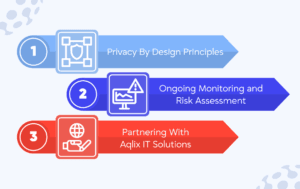
1. Privacy By Design Principles
Privacy by design provides guidelines to build in privacy throughout the entire design process. This includes reducing the amount of data that is collected, following best practices in secure coding, and restricting access to sensitive information.
If privacy is part of the design topology, fail exposure potential drops tremendously. Developers are able to ensure data processing processes strictly adhere and remain transparent.
This also helps to ensure compliance with privacy laws. By preparing in advance, businesses can prevent expensive revisions and minimize legal liability.
2. Ongoing Monitoring and Risk Assessment
Data security is not a one-time event. Because the SaaS model is always on, it also means it’s always a target for possible threats. Regular security inspections are being carried out in order to find any potential weaknesses so they can be fixed before becoming a serious issue.
Some of what those tools do is look for aberrant behavior and trends in the performance or use of the system. That way, businesses can be notified of any suspicious behavior in time. Real-time surveillance can help to ensure prompt privacy preservation in diverse situations.
Ongoing training sessions and educational programs also enable teams to understand what it will take for them to contribute towards data security. The culture of accountability is a pillar for sustainable privacy preservation.
3. Partnering With Aqlix IT Solutions
Constructing a secure SaaS platform is not only best practice, it’s strategic. Aqlix IT Solutions Works in partnership with companies for the development of artificial intelligence, machine learning and custom software solutions with a focus on privacy.
Aqlix is dedicated to secure architecture and responsible data management for organizations developing scalable platforms that enable innovation without compromising sensitive assets. This well-balanced way makes certain that organizations are able to scale as they need without compromising on privacy.
Conclusion
Increasing SaaS application data privacy concerns Increased Reliance on Cloud and AI-Driven Services Companies are increasingly reliant on cloud-based solutions and AI in their day-to-day operations. Centralized storage, 3rd party apps integration and AI data processing are other challenges to monitor.
Businesses that prioritize privacy establish more trusting relationships with customers and are well-positioned for long-term success. With the support of battle-hardened technology partners such as Aqlix IT Solutions, organizations can create SaaS-based platforms that support innovation, compliance, and scale.
Frequently Asked Questions
Why is data privacy important in SaaS applications?
User data privacy is very important since SaaS platforms deal with users’ sensitive information. Protecting this information is crucial to preventing data breaches, staying in compliance with laws and regulations, and setting an example of trustworthiness for your customers and partners
What are the main risks in SaaS data privacy?
Typical risks are unauthorized access, 3rd-party abuse, and mishandling of the data. Otherwise, centralized storage and AI data processing would face monolithic attack surfaces.
How does AI development affect data privacy?
Training AI involves handling of large data sets, which very well may have sensitive information contained within them. The trust from AI practices may also demonstrate that data is used in a responsible way and protected from the moment it enters and through the life of a system.
How can businesses improve SaaS data security?
Security may also be improved with data encryption, role-based access, regular audits and privacy by design. Custom software solutions also allow you to have more control over your data’s security.
What role does a technology partner play in securing SaaS platforms?
Partnering with a technology provider allows secure architecture to be developed and deployed including modern-day security software tools and privacy-compliant solutions. Companies like Aqlix IT Solutions assist in building SaaS systems for businesses, which are both scalable and respectful of privacy.