

They thrive in a rapidly changing environment where speed, creativity and flexibility are what define survival. Business Transformation enabling your startup to enhance processes, strategy and technology to sustain growth. Through innovative approaches to getting the work done and delivering value, young companies can scale up efficiently and compete effectively with established players.
The digital transformation is a key aspect on the route there. From cloud-based platforms to ML-fueled insights and chatbot-assisted customer engagements, new technologies enable startups to run better and respond more quickly than ever before. With the help of technology consulting, startups can match their vision with actionable plans for long-term success.
Why Startups Should Care About Business Transformation
Most new companies are relatively lean and clear in shape. As such institutions mature, they may also move beyond existing systems and processes. Overhauling your business is vital in enabling you to scale, innovate and operate efficiently.
Teams are now building products and hitting the market in much earlier stages. With time, businesses need operational efficiency and faster decision making as well as better customer engagement. A business transformation allows the startups to turn when they need to and continue to keep their foot on the accelerator.
1. Growth Challenges Facing Early-Stage Startups
Startups encounter a multitude of challenges as they scale. Underfunded, understaffed, and ever changing priorities often lead to an overstraining of operations. If we do not have the processes in place, growth will be challenging for you.
Operational waste can spring up with surging demand. Manual processes, disparate tools and ambiguities about roles can slow them down. Business transformation stands to provide solutions for these struggles by introducing more efficient systems, well-defined processes, and scalable ways of doing business.
2. Business Transformation Versus Digital Transformation
Business transformation and digital transformation are highly related but not the same. Business transformation effort emphasizes the enhancement of an organization’s strategy, operation and structure. Digital adaptation looks at the role that technology will play in facilitating such changes.
The two approaches go hand in hand for startups. Process transformation is implemented by new processes enabled with technology solutions such as cloud platforms, machine learning and automation tools. If done correctly, the digital transformation is an enabler for a wider business transformation.
Digital Transformation Supporting Business Strategy
Digital transformation is best when it follows business objectives. Startups shouldn’t implement technology just for the sake of it, but they should look at where digital tools can help them scale faster, become more efficient and make better calls.
The digital transformation is the growth engine when it enablement aligns to strategic goals. Technology brings with it the means for startups to boost productivity, increase intelligence and implement scalable systems that foster growth.
1. Aligning Digital Initiatives With Growth Goals
Startups frequently use digital technology to enhance performance and revenue. Cloud-based platforms, analytics systems, and AI-based solutions can help teams to monitor performance and uncover emerging openings.
Linking digital to the business agenda helps IT and technology investments deliver value you can measure. For instance, automation tools can save time and effort of manually chasing leads and ML-powered analytics can help understand customer behavior and optimize your targeting strategy.
2. Improving Agility and Decision-Making
Digital transformation enables startups to be agile when it comes to what the market dictates. Real Time information enables teams understand, decide and take corrective actions.
Quicker decision making encourages innovation, and ensures companies are competitive. Predictive analytics, chatbots and automatic workflows are among the tools that allow startups to stay agile without compromising accuracy and consistency.
Managing Change and Tracking Growth
Business transformation is about people, leadership, culture and measurable results. Start-ups that are good at change when coupled with results delivery can last for the better and scale.
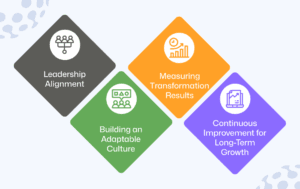
1. Leadership Alignment
Leadership is key to success in any transformation. Founders and leaders have to effectively communicate goals and lead teams through new processes. Consistent supportive leadership makes it easier for the team to navigate distress.
2. Building an Adaptable Culture
A flexible workplace culture allows start-ups to adapt to changing technology and workflow. Learning, collaborating and sharing knowledge help your teams be ready to address the continuous changes and always strive for better solutions.
3. Measuring Transformation Results
By monitoring and managing KPIs it is possible to determine the effectiveness of transformation efforts. KPIs such as productivity gains, time to market and customer retention give you an idea of how far you have come.
4. Continuous Improvement for Long-Term Growth
Change is not a one-time event. Startups need to be constantly iterating on strategy and testing new tools, learning from the best and incorporating these advancements while still keeping in line with long-term growth plans.
Conclusion
Business metamorphosis enables startup efforts to establish firm foundational roots for sustained growth. Through the optimization of methods, development of better cooperation, and strategy-technology coordination, start-ups can scale faster.
As these companies journey toward that unfolding possibility, digital transformation is helping to power better decision-making, automation and customer engagement. Thanks to partners like Aqlix IT Solutions, startups can build scalable processes and priorities that lead to long-term success.
Transformation is continuous as startups scale. Further, continuous improvement, agility and the right technology to drive profitability are essential in order for companies to be competitive tomorrow.
Frequently Asked Questions
What is business transformation in startups?
Transformation in Startups Business transformation in startups focuses on fine-tuning processes, strategies and organizational structures to ensure there is a right environment for growth. It provides businesses the flexibility to address dynamic markets, optimize resources and design systems that can facilitate growth for years.
How is digital transformation different from business transformation?
Digital transformation is about incorporating technology, cloud platforms, ML and automation. Business transformation can involve even more sweeping changes in how a company operates, its strategy or overall structure. Both work hand-in-hand to support startups growth and performance.
Why is technology consultancy important for startups?
Technology consultancy works with startups to align digital tools and business goals. It assists with planning the system selection and conversion while ensuring transformation efforts generate long-term value and support sustainable growth.
Which areas do startups usually transform first?
Startups concentrate in many cases on the operations, customer experience and team building. Enhancement of these areas contribute to the scalability, efficiency and stability of business as a whole.
How can startups measure the success of transformation?
Startups can monitor a metric such as efficiency improvements, customer retention, revenue growth and scalability. Ongoing assessment is needed to make sure business transformation and digital transformation both maintain and deliver long-term success.

