

In the fast-moving world of business today, change driven by new technology is no longer a choice it’s a requirement. Businesses in all sectors face ongoing pressure to become more efficient, adjust to changing customer demands and react swiftly to market changes. Disruptive technologies in AI, cloud computing, SaaS platforms and advanced analytics are providing enterprises with ways to re-envision their business models and value proposition.
Digital transformation is as much about technology-enabled changes as it is about redefined processes, decision-making and culture within the organization. Given the right approach and coaching, companies can unlock sustainable growth with digital tools, while being able to withstand market competition.
Core Technological Drivers of Transformation
Business reinvention in the digital age is propelled by technologies like AI, automation and advanced analytics, as well as on-demand platforms and cloud. These technologies allow businesses to drive efficiency, make better decisions, and grow digital platforms at scale.
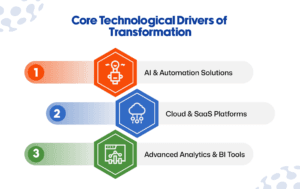
1. AI & Automation Solutions
Artificial intelligence (AI) and automation are at the heart of business change today. Systems enabled by AI can process vast amounts of information, recognize patterns, and assist in quicker, better decision-making. Automation decreases reliance on manual operations, which will help orgs reduce errors and enhance uniformity across processes.
From aI-to-LlM based automation solutions to AI-powered chatbots and LLM-assistants, those capabilities have a common denominator of improving productivity and letting employees work on tasks with higher added value. In the long run, AI also enables ongoing improvements by leveraging operational data to learn and improve results over time.
2. Cloud & SaaS Platforms
Today’s dynamic business models depend on the flexibility that cloud computing and a SaaS platform can offer. Instead of dead-on-arrival on-premises hardware, companies can grow resources as necessary and get into systems from anywhere. Such flexibility is useful for distributed teams and scaling businesses.
Application deployment, system updates, and integrations are likewise made easier by cloud platforms.” When more businesses embraced continuous cloud strategies, they achieved more flexibility in the business and better reliability and control of costs.
3. Advanced Analytics & BI Tools
These tools enable companies to transform raw data into useful information that can be used for decision-making. By aggregating data from multiple locations, these tool offer a holistic view on performance, customer behaviour and operational trends.
Planning is enhanced with predictive analytics, which forecasts the results and risks of potential actions. As the pace of data-driven decision-making accelerates, analytics and BI platforms provide a strong foundation for strategic growth.
Partnering with Aqlix for Transformation Success
If you want to make sure it all goes right, business transformation demands knowledge of the technology and vision for your strategy. Aqlix offers IT consultancy services enabling clients to evaluate their existing environments, delineate transformation blueprints and implement enterprise wide digital solutions.
Aqlix is designed to meet the needs of businesses accelerating their digital transformation journey with AI, cloud and data-driven initiatives.
The strategic consulting and implementation plan helps businesses align technology investments with long-term growth goals.
Measurable Benefits of Technology-Driven Transformation
Technology-led change makes a real difference with benefits such as cost savings, speed or improved data accuracy. Businesses also benefit from higher quality customer interactions, business agility, and long-term competitiveness.
1. Cost Efficiency
Cost savings is one of the first and most tangible results of technology-led change. Automation slashes 5, minimizes redundant labor through such robots and cloud infrastructure doesn’t require you spend a ton of cash before future kit benefits. AI-powered monitoring systems can also detect wasteful use of resources, and potentially stop costly interruptions.
These efficiencies produce reduced operating costs and better management of available cash throughout the corporate network.
2. Improved Customer Experience
Companies can provide more personalized and faster customer experiences thanks to cutting-edge technology. AI-driven recommendation engines, chatbots, and real-time support tools enhance response time and engagement within digital platforms.
With an understanding of customers served by analytics, companies can deliver offerings and interactions that are more relevant to those individuals, which in turn drives better relationships and greater loyalty.
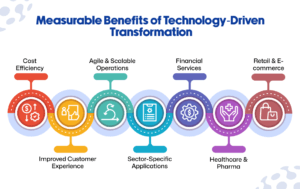
3. Agile & Scalable Operations
Face Changes Technology-centric companies are more agile. Web/cloud systems, apps with modules, and automated business processes reduce the barrier of scaling when one grows, consolidating to global operations.
It’s this agility that enables swifter product launches, more seamless market penetration, and a greater resilience to unpredictability or explosive growth.
4. Sector-Specific Applications
Below is an analysis of how innovative technologies are utilized differently within the various sectors to meet their specific challenges and objectives. Transformation takes new shapes depending on the sector: whether it be AI-driven risk analysis for finance, predictive analytics for healthcare or supply chain management in retail, the nature of transformation evolves to suit individual industry needs.
5. Financial Services
In financial services the cloud can be used to drive automation, compliance and risk management with cutting-edge technology. Credit scoring, fraud detection, transaction monitoring the list goes on and efficiency isn’t all it does better than us.
Advanced analytics also allows banks to deeply understand customer behavior with personalized services in a way that complies with banking regulations.
6. Healthcare & Pharma
Healthcare and Life Sciences Organizations utilize technology to provide better patient care & streamline operations. Online patient management systems cut down on appointments, records and communication costs associated with administration.
Through predictive analytics, healthcare providers can aid early diagnosis and treatment planning with improved quality of care (QoC) while effectively utilizing resources for service demand (SD) projection.
7. Retail & E-commerce
Technology is critical for managing supply chains and customer engagement in retail and e-commerce. AI-powered demand forecasting ensures inventory levels are right-sized, while analytics enhances pricing and promotion tactics.
With data insights fueling personalized customer journeys, user experiences improve and businesses can gain repeat customers in the digital race.
Addressing Transformation Challenges
Despite its benefits, business transformation through technology comes with challenges that require careful planning and execution.
- Budget restrictions: It may require some significant investment in technology and capabilities up-front. Best use cases will have the highest impact, which helps getting early returns.
- Legacy systems: Aging infrastructure might cap integration and scalability. API-based approaches and gradual modernization lower the level of disruption.
- Workforce readiness: Training of staff is necessary so that they can effectively work with the new technology. Ongoing education initiatives help drive adoption more smoothly.
- Calculating ROI: Defined performance measures and standards allow organizations to monitor progress and justify investment.
Proactive management of these four challenges increases the odds of successful and sustainable transformation.
Conclusion
Modern Business Transformation is powered by cutting-edge technology. With access to AI, cloud platforms, SaaS-based services and advanced analytics, companies have the ability to optimize operations, create better customer experiences and stay competitive. By working with a knowledgeable partner like Aqlix IT Solutions to create a strategic road map, companies can make the most of digital transformation as a lasting engine for growth.
Frequently Asked Questions
What does business transformation through technology mean?
Digital business transformation is the application of digital technologies – cloud, automation, analytics and artificial intelligence (AI) – to improve processes, customer engagement and decision making. It’s a model of long-range operational improvement, not mere short-term technology adoption, that all digital efforts should be based on and should serve overall business objectives.
How is AI helping to transform businesses?
AI enable business transformation via automate laborious tasks, analyze huge data and generate predictive insights. Machine learning models, LLMs and chatbots are some of the technologies that enable organizations to become more precise, less erroneous in their operations, and able to manage interactions with customers more effectively while also making strategic decisions quickly based on data.
What is the role of cloud computing in digital transformation?
Cloud computing provides scalability, flexibility and cost-control by offering on-demand access to infrastructure and applications for businesses. It facilitates remote work practices, quicker rollout, easy integration and ongoing updates, enabling organizations to more easily adapt to new operational and market needs.
Who are the winners of tech-powered change across sectors?
Digital transformation offers exceptional opportunities for sectors like financial services, health care, retail and the manufacturing and technology industries. These industries deploy AI, analytics, and cloud platforms to drive efficiency gains, monitor risk more effectively, improve customer experiences and supply chains, while adhering to regulations.
How can companies get started on their journey of digital transformation?
Businesses can start by evaluating existing processes, pinpointing functional holes and setting transformation goals that are explicit. Technology consulting enables companies to determine the right digital tools, and it will enable businesses to soundly navigate change, train employees and evaluate performance for lasting and adaptable transformation results.