

Today’s businesses depend on a range of software applications like Oracle to keep their business operations, customers, finances and HR on track. Although necessary, they tend to be applied in isolation. Isolated systems lead to data silos, manual workarounds and delays that diminish visibility and slow down decision-making. The integration of aging businesses is increasingly difficult to reconcile and take under control with business growth.
Oracle Integration Cloud solves this problem with a single, unified platform linking your applications and IT environments together. With the reduction in complexity of how systems interact with each other Oracle integration delivers real-time data exchange and automation. This connectivity significantly contributes to better productivity and fewer mistakes.
It’s no longer down to integration. It’s increasingly a necessary part of doing business for companies that want agility, scalability and uniformity in their operations.
What Is Oracle Integration Cloud (OIC)?
Oracle Integration Cloud is a cloud-based alternative for integrating Oracle applications with third-party apps and on-premises systems. Ultimately, it’s designed to facilitate data exchange and business processes without the need for complication custom code.
OIC comes with pre-built adapters for common enterprise apps like Oracle ERP, Oracle HCM, Salesforce, and other types of database. These adapters intercede in the connection to abstract away authentication, data mapping and communication protocol.
The platform also offers visual integration mechanisms that let teams design their workflows using drag and drop interfaces. Process automation capabilities allow orchestration across any number of systems, so organizations can standardize processes and still remain agile.
Oracle Integration Cloud brings together Application Integration, Process Automation and Visual Builder in a single platform to help support scalable enterprise connectivity.
Key Benefits of Oracle Integration
Oracle integration provides tangible advantages that have been identified as important to operations and business decision-support.
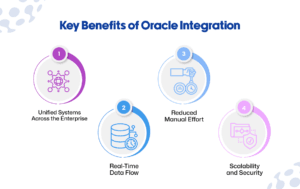
1. Unified Systems Across the Enterprise
Oracle Integration Cloud facilitates and offers out-of-the-box connectivity across the CRM, ERP, and HCM segments of a business. This consolidation makes information more seamless across departments, eliminating discrepancies and improving synchronization.
As everything is real-time between systems, teams can have one source of truth that allows for more accurate reporting and planning.
2. Real-Time Data Flow
Near real-time allows organizations to eliminate batch processing and human process for transferring data. Update information is pushed directly to connected apps.
This dynamic visibility increases responsiveness and enables fact-based decisions across finance, sales, operations and customer service.
3. Reduced Manual Effort
One of the benefits of integrating with Oracle is automation. Manual tasks like data syncing, approvals and notifications can be automated.
Minimizing manual effort minimizes the risk of errors and allows teams to concentrate on business-critical tasks rather than administrative work.
4. Scalability and Security
Oracle Integration Cloud runs on Oracle’s hardened multi-tenant cloud architecture. It provides enterprise-class security, compliance and scalability.
As you expand your company, or add new applications to your stack, integration workflows can scale without costly rework of the entire integration story, making für long term sustainability.
How AI Enhances Oracle Integration
Artificial intelligence introduces the ability for intelligence and agility to Oracle integration flows. AI features improve the way sense-making and responding to data changes by systems is organized.
Smart routing AI decides where to send data and processes around. This will better performance and minimize latency with the integrations.
Anomaly detection detects any abnormal data patterns or if the integration is failing in real-time. Early identification enables teams to rectify problems before they have any effect on the operations.
Automatic data mapping is based on machine learning for simplified transformation of data formats. It decreases development times and increases the precision of integration.
Organizations are building smarter and more resilient integration architectures by combining AI with Oracle Integration Cloud.
Common Use Cases
Oracle integration is applicable for diverse operational use cases in different industries.
1. ERP and CRM Synchronization
Because most organizations run finance and operations processes on Oracle ERP, but are likely using Salesforce or something similar for managing customers. Oracle Integration Cloud keeps data in sync between these systems, so that you have consistent customer, order and billing information.
This integration ensures that your teams have access to the latest insights and forecasts, while also delivering the best customer experience.
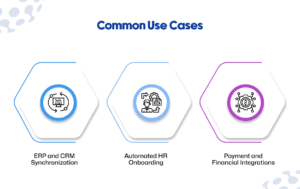
2. Automated HR Onboarding
Human Resources (HR) departments oversee initiation with many applications payroll, identity and training systems. Integration with Oracle automates onboarding workflows so no time is wasted and the employee experience is optimised.
Access, documentation and system credentials for new joiners are delivered with no human involvement.
3. Payment and Financial Integrations
With the payment gateways tied in to Oracle applications, the transaction processing and reconciliation are perfect. Automatic connections cut down on the errors and increase clarity with your financials across packages.
Here are some examples of how Oracle integration helps deliver business agility through efficiency in core operations:
Why Modern Businesses Need To Integrate
Integration is foundational for enabling both agility and innovation. Decoupled systems will hinder an organisation’s ability to react promptly to market dynamics or its client requirement.
With this integration of systems, companies can become more flexible. New solutions are introduced without affecting current procedures. Processes can be refined on an ongoing basis based on shared data and automated logic.
They also improve customer experience when data flow is smooth. Support gets full visibility into customer histories, and service delivery becomes faster and consistent.
In a moving target environment, integration is not merely a technical necessity but an essential competency that enables growth and sustainability.
Role of Technology Consulting in Oracle Integration
More than tools are needed for successful integration. It’s important for organizations to know what their business processes are, how data flows through these processes, and long-term objectives in design of an integration plan.
Technology consulting supports business leaders in assessing, integration readiness, and identifying high-impact use cases. Consultants help organizations to learn how to decide on the right Oracle integration patterns and designing for scale.
As a result of consulting, business owners and decision makers become informed about how integration will help the growth, efficiency and innovation in their businesses. “The key for me is to do that planning out front to mitigate risk and make sure integration is in line with business priorities”
Aqlix employs this consulting-led methodology to assist companies in designing Oracle integration solutions based on their operational “as-is” state and where they want to be (“to-be”).
Conclusion
The Platform for Automation and Connectivity Oracle Integration connects the apps you use everyday with your businesses, so IT can continually use Oracle’s out-of-the-box connectivity to create transformative solutions without having the burden of integrating them together. These tools enable operational efficiency, accuracy and scalability for business operations.
The more digital tools that organizations add, the harder it becomes to keep track and visibility. When you add in Oracle integration, AI and automation, the resiliency of an enterprise is improved even more.
Aqlix assists companies in optimizing business process by focusing on Oracle integration solutions that promote agility, cost-effectiveness and eventual innovation through technology consulting and custom implementation options.
FAQs
What is Oracle Integration Cloud?
Oracle Integration Cloud: through this product native and third-party (such as Workday) applications can be connected, business processes automated and data exchange in real-time across systems is possible.
Can we use Oracle Integration Cloud with non-Oracle apps?
Yes. OIC supports out-of-the-box adapters and APIs so you can integrate with various, third-party and on-premise systems.
What are the advantages of Oracle integration to businesses?
Using automation to ensure data flow and avoiding manual interventions clear the path towards enhanced accuracy, speed, and decision-making.
Is Oracle Integration Cloud enterprise ready?
Yes. Built on Oracle’s secure cloud infrastructure, the application is adherent to enterprise security and compliance standards.
The Importance of Technology Consulting in Integration Projects
IT consultancy guarantees that the integration strategies correspond with business goals, minimizes effect on existing architecture and reduces implementation risk.