
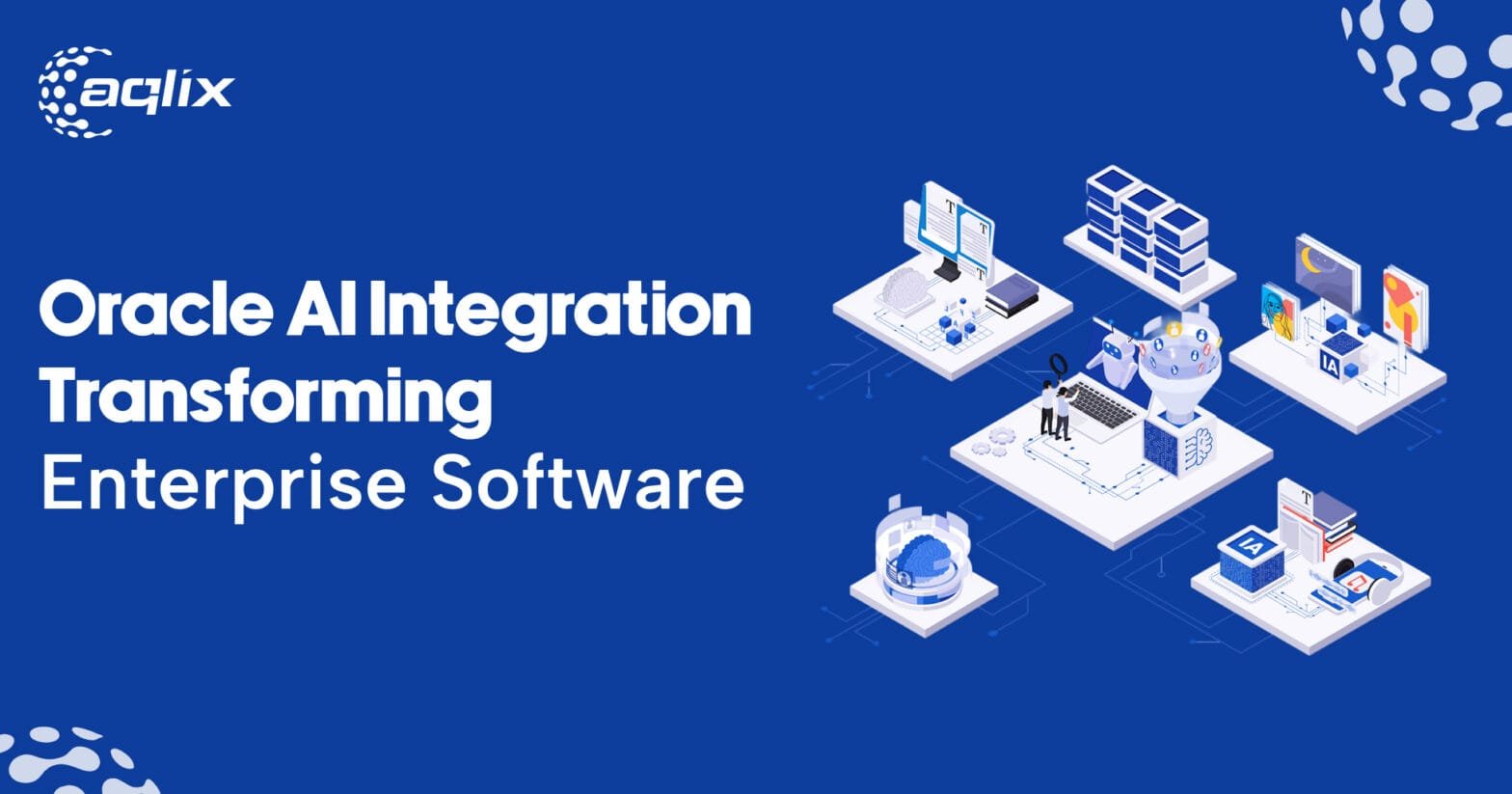

Artificial intelligence is transforming how enterprise software is built, deployed and used across industries. Today’s businesses are functioning in the digital ecosystem, generating data at every pinchpoint of customer interactions, operational processes and connected devices. This data should become actionable insights, it is just that traditional software tools are not enough. Oracle is addressing this issue by integrating AI features through its whole suite of enterprise apps.
Simply put, artificial intelligence is quickly becoming the layer in everything from databases and analytics to ERP and CRM systems that pushes automation, accuracy and decision making. These improvements give the opportunity for businesses to move from reactive operations to predictive and adaptive business models.
A em estas mudanças as empresas precisam de orientação e metodologia para implementar. With technology consulting and custom software development, Oracle AI service providers like Aqlix help businesses understand Oracle AI services and how they can meet actual business needs. This is to make AI adoption a real value, not just an experiment.
Oracle’s AI Vision for Enterprises
Instead of simply relying on AI as an independent feature, Oracle’s AI approach has been centered around putting intelligence into enterprise systems from the start. This enables businesses to take advantage of AI without needing a complete overhaul of their technology stack.

1. Oracle Cloud Infrastructure AI Services
Oracle Cloud Infrastructure offers a rich set of AI services that cover ML, NLP (Natural Language Processing), vision and predictive analytics. The services are meant to be easily integrated with this databases and applications, allowing organizations to bring AI to actual production data.
Organizations can use OCI AI services to build intelligent applications that scale reliably with» out compromising privacy, performance and compliance needs.
2. AI Across Oracle Enterprise Applications
AI capabilities have also been woven into Oracle’s ERP, CRM, HCM and analytic applications. In ERP, AI aids demand forecasting and financial planning. In CRM systems, it increases customers insights as well as increase customer engagement and retention. HCM systems leverage AI To Enhance Talent Acquisition, Workforce Planning, Employee Experience.
This integrated unification ensures intelligence sharing across all departments, breaking down the silos of information and promoting data-driven decision making.
Oracle AI Adoption and the Role of Technology Consulting
Oracle has powerful AI and ML capabilities but successful application of these technologies come down to proper planning, business strategy alignment. Technology consulting fulfills a critical function of linking potential AI to actual outcomes.
Consulting engagements allow business leaders to evaluate their AI preparedness, discover key use cases and pinpoint tangible measures of success. Consultants aid companies in deciphering which Oracle AI functionality fits their processes, and how to get it stuck onto the existing systems without gumming up the works.
The technology consulting helps manage change with considerations like governance, data quality and user adoption. Through a blend of advice and technology know-how, companies can bring this into their organizations in an orderly fashion. Aqlix uses this consulting-led approach to assist companies in translating advanced AI theory into deployable, enterprise-ready solutions.
Key AI Features Transforming Enterprise Software
Oracle AI integration brings all sorts of smart features into play, which, in a very literal sense impact everything from how your corporate applications run to what they produce.
1. Automated Insights
Artificial intelligence based analytics is able to automatically detect trends, anomalies and performance factors from big data. Instead of creating the reports themselves, users are seeing that information as it’s happening in the data.
These automatically generated insights allow decision-makers to directly focus on strategic action rather than analyzing data, making the entire team more efficient.
2. Predictive Intelligence
Predictive analytics can help enterprise systems to predict the future according to historical and real-time data. Demand forecasting, risk estimation and performance forecast are just a few of many business functions that can be supported by Oracle artificial intelligence (AI) models.
This function enables enterprises to be proactive, streamline resources and plan more effectively.

3. AI Chatbots and Conversational Interfaces
Artificial intelligence powered chatbots are changing the way people use enterprise software. Oracle-based bots can improve customer service by processing common questions and helping users work through procedures. Within HR systems, conversational interfaces help employees perform tasks such as onboarding, benefits and internal requests.
These are some of the tools that help in providing accessibility. And they lessen support teams burden also.
4. Process Automation
Automation with AI decreases reliance on manual processing. AI is used by Oracle systems to automate approvals, validate data and handle exceptions. This is not only faster but eliminates errors and lowers operating costs.
The automation frees teams to focus on more valuable work, and enforces consistency across processes.
Business Impact of AI-Enabled Oracle Systems
AI infused in Oracle enterprise solutions drives real business results across all industries.
Better decision making might be the biggest pay-off of all. Powered by AI, insights deliver precise, up-to-the-second details to inform strategic planning and tactical execution. Leaders can react more quickly to market changes and internal performance adjustments.
Operational efficiency is also increased because automation eliminates a majority of the manual labor and processing time. Predictive analytics allow organizations to make supply chains, financial plans, and workforce adjustments in ways that save both costs and boost productivity.
User experience is also big hit. Customizable interfaces, smart recommendations and conversational tools are some of those that make their enterprise systems more usable and far more relevant to your particular role. This raises usage and return on technology investments to the highest possible level.”
Future Outlook
Oracle’s plans for AI-based enterprise applications keep getting wider. Autonomous databases, intelligent interfaces and deep systems integration wave is underway and will help define the next era of enterprise software.
Upcoming Oracle applications will further enable self-optimizing processes, explainable AI models and real-time insight applications throughout cloud deployments. These developments will additionally reduce human intervention while raising the confidence and transparency in decisions made by AI.
Here are a few reasons why businesses considering the Oracle AI platform, and want to move quickly on embedding AI into their current operations: 1) For financial services organizations that invest early in Oracle AI integration, being able to adapt as markets adjust, regulations change or customer requirements evolve is going to make or break you down the road.
Conclusion
Oracle AI is transforming enterprise software that embeds intelligence across data, applications, and business workflows. Machine learning, predictive analytics, and process automation allow companies to operate with greater precision, efficiency and speed.
As AI is incorporated into enterprise systems, adoption needs to be structured. Technology consulting, along with platform expertise and custom software development is what makes it easier for businesses to harness the power of Oracle AI. Aqlix collaborates with companies to deploy Oracle AI solutions that further strategic objectives, optimize processes and foster long-term growth of their operations.
FAQs
What is Oracle AI integration?
The integration is talking about in its applications AI universe alludes to plugging AI into Oracle databases, cloud services and enterprise apps so that they can become more automated and smarter at decision-making.
What are the improvements by Oracle AI on enterprise workflows?
Oracle AI applies artificial intelligence to automate repetitive tasks, deliver predictive insights, and provide a more natural user experience so that users can focus on making decisions based on known data rather than monitoring data.
Which Oracle products does AI work on?
“Oracle AI technologies are infused into every clouds services that we offer, including OCI, ERP, CRM, HCM and the analytics platform as well as our application development tools”
Can mid-market business benefit from Oracle AI?
Yes, Oracle AI services are scalable and customizable for middle-market companies?
What is the significance of technology consulting when looking to implement AI?
Technology consulting is another way that organizations can hone in on the appropriate AI use cases, as well as align solutions with business objectives and streamline their implementation through enterprise systems.

