

Legacy systems are typically considered barriers to advancing the business, so many organizations have thought that full replacement was the only way forward. Such an assumption can lead to high cost, downtime and loss of critical business knowledge developed over years of operation. Legacy modernization does not need to mean reinventing the wheel. Oftentimes, the practical and sustainable solution is to reengineer and redevelop what you have.
Keeping proven workflows and modernizing legacy technology layers can make organizations more performant, secure, and scalable without having to overhaul everything in the process. This is a means for organizations to manage change while preserving continuity. Aqlix adopts a strategic modernization approach emphasizing smart (not simplylift and shift) rebuilding among companies, moving away from legacy applications to future-ready capabilities with less risk and more long-term value.
Why Full Replacement Isn’t Always the Best Solution
Many developing businesses wonder if they should invest in new systems when performance lags, integration is problematic or there are security worries. But full replacement too often brings large risks that wipe out supposed improvements. One Line domain migration or a lot of users in a direct move means significant due to the need to invest significant APEX and heavy change management.
The legacy systems are usually riddled with deep-rooted business logic that is an accumulation of years of experience. Ripping out these systems entirely will result in the loss of valuable processes that may not be done as well again. Another major hurdle in data migration is the transfer of data, as large datasets and system dependencies might be involved. Organizations often have protracted delays or diminished efficiency within the move process that negatively impact both employees and customers.
Core Steps in a Rebuild Strategy
A well planned rebuild plan will keep the modernization initiative in synch with business demands. Every stage aims to minimize risk and enhance flexibility, as well as the resilience of the system. And it’s this very incremental approach that has been allowing companies to modernize with confidence.
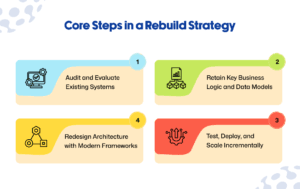
1. Audit and Evaluate Existing Systems
The road to modernization starts with getting a full understanding of today’s systems. This step involves identifying components that perform well, areas causing bottlenecks, and technologies that no longer meet business needs. A comprehensive audit enables the organization to identify system dependencies, performance bottlenecks as well as security holes. Plain assessment enables the modernization campaign be more business led rather than strictly technology led.
2. Retain Key Business Logic and Data Models
One of their most precious jewels is one that many organizations already have mature business logic. Maintaining this reasoning allows for consistency and minimizes the threat of disruption. Data models related to reporting, compliance, and customer interactions are also retained at this stage. When they break logic away from the old interfaces or infrastructure, businesses are empowered to modernize without losing decades of intelligence that’s been wired inside their systems.
3. Redesign Architecture with Modern Frameworks
When crucial systems/components have been pinned down the system architecture is reconstructed to fit the cutting edge technologies like microservices, APIs and cloud based services. This makes it more flexible, scalable and robust. Decoupled components maintainability headaches Modular architectures allow for updating of individual pieces instead of the whole app, simplifying maintenance and accelerating fast- pace innovation. Availability and distributed operations are further improved in cloud environments.
4. Test, Deploy, and Scale Incrementally
Gradual introduction enables risk reduction, and leaves the system infrastructure unchanged as it is modernized. All RareRover Land Rover parts are tested on vehicle so that you can be assured of their quality and performance. The benefit is that you can keep your uptime, and just get better over time. “Modernized systems can now be scaled incrementally with no impact on the business.
Benefits of Rebuilding Over Replacing
Recovery delivers measurable improvements without the tangles of replacement. Firms gain more security and flexibility, while ensuring business continuity. It’s a sustainable path to long-term digital growth.
1. Faster Return on Investment
It’s also quicker many times to start anew when modernizing legacy systems. Focusing on high-impact locations allows companies to drive performance improvements and cost savings faster. When your development period is shorter and you invest less into the implementation, companies get a faster return on investment without waste.
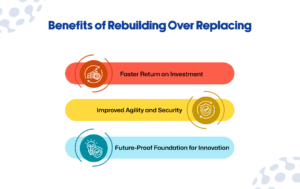
2. Improved Agility and Security
Old architectures become more agile, and so it becomes easier for business to respond to changing needs. Click to read more Genesys provides the leading cloud contact centre platform with curated, artificial intelligence (AI)-driven innovation. These enhancements help meet new compliance mandates and better secure sensitive data.
3. Future-Proof Foundation for Innovation
A restored system versions a stable base for future innovations. Current platforms can be easily connected to analytical tools, automation and future technologies with less need for redesign. Such nimbleness means businesses can proceed with new digital initiatives without fear of having to abandon existing systems should they scale.
How Strategic Modernization Supports Business Growth
Upgraded systems are instrumental in advancing sustainable development. Better performance Operational friction is reduced so teams can spend time on strategic priorities instead of maintaining the system. By scaling up, the system can handle more work without sacrificing reliability.
Newer architectures also provide improved data visibility and integration, which allows companies to make better decisions across business units. For companies taking to new markets or services, rebuilt systems are flexible enough to nurture continued change. Aqlix engages with a company and focuses on their transformation, building the modernization plans that map back to growth strategies for comprehensive and adaptive technology modalities because if IT is running too slow, then you’re not growing.
Conclusion
Dragging and dropping legacy doesn’t mean throwing away what you have, or starting over from scratch. Instead, the smarter approach is to rebuild strategically, holding onto what works while improving and modernizing what stands in the way of growth. Keeping the core business logic while modernizing architectures means organizations can take advantage of better performance, security and scalability with less disruption.
Aqlix specializes in helping businesses transform legacy systems into future-ready platforms that support digital transformation goals. Delivered through smart rebuilding strategies and modern architectures, organizational leaders can be confident their technology adapts as quickly as they do.
Frequently Asked Questions
What is legacy system modernization?
Legacy systems modernization means transforming old technologies but keeping valuable business logic and information intact. It provides better performance, security and scalability without replecament of the entire system.
After years of experience, is rebuilding better than replacing old systems?
For the most part, rebuilding is more economical than replacing and less invasive on your home than a new make-over. It enables to keep successful workflows and innovation of technology layers for growths in future.
How long does it take to rebuild a legacy project?
These timetables will differ depending on the complexity and scale of the system. Here too, incremental rebuilds can yield benefits earlier than complete replacement; organizations will be able to see results more quickly.
Systems Rebuild: Can we Make them work with modern technology?
Yes. Reclaimed systems are engineered to work natively with cloud offerings, APIs and most recent technologies for future innovation and swift scaling.
What is Aqlix’s approach to legacy modernization?
Aqlix invest behind a strategy of rebuilding to keep the core but modernize architecture. This process mitigates risk, manages costs and ensures technology is in line with the overall business strategy.