


Increasing workloads, competitive threats and elevated customer expectations are overwhelming businesses. AI continues to be touted as the answer in addressing these challenges, but most organizations are skeptical or hesitant due to perceived complexity and cost. AI is something that can be rolled out, and so it’s accessible even to smaller companies.
The idea would not be to replace systems out there, but instead to boost humans’ capacities and ability by virtue of adding in accuracy, speed and intelligent insights into what teams are already doing. Courtesy of practical digital transformation and orderly planning, businesses are able to maximize the benefits AI has to offer without disrupting the everyday. Aqlix provides a path for businesses to gradually adopt this model, so its AI journey is slow, but steady and in line with its long-term plans.
The Importance оf Artificial Intelligence іn Businesses Today
Many businesses are already slow to board the AI bandwagon thinking it’ll necessitate radical new systems or expert technical know-how. AI is helpful in small doses, too, allowing teams to automate and iterate tasks, eliminate errors and make smarter decisions.
By pairing high-level technology consultation services with structured operational planning, the Aqlix partnership allows companies to realize complex AI aspirations in a practical manner that moves their larger digital transformation agenda forward.
Understanding AI and Its Business Potential
AI is not about building machines that can do everything we can; rather, it’s about finding ways to improve our businesses a little bit each day. Because if you understand what it’s actually capable of at its heart, then you can use that more judiciously and responsibly as an organization.
What AI Really Does
AI automates rote work, whether it’s sifting through data or generating basic reports that are offloaded to teams. It can scour massive bodies of data at a velocity people can’t match, pulling out insights that they never could.
These capabilities also deliver faster decisions and better accuracy across multiple applications, thus ultimately increasing overall system reliability.
AI as a Part of Digital Transformation
AI’s job is to keep the operations and work flows smooth in today’s organizations.” It is designed to work in combination with the cloud based applications, orchestration frameworks, Big Data platforms and support enhanced process efficiency and reduced manual effort.
Incorporated with a strategy as it’s meant to be, AI is the framework that supports future-proofed business processes that evolve with your business.
Simple Steps to Improve Your Business with AI
AI comes in the form of baby-steps. They enable organizations to begin where the need is great and grow it from there as confidence grows.
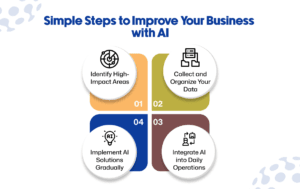
1. Identify High-Impact Areas
Start by analyzing the company’s repetitive, time-consuming and mistake-prone tasks. And areas like customer service or inventory management or sales reporting often show quick gains with AI.
Focusing on high-impact segments ensures measurable returns and helps build internal support for broader digital transformation.
2. Collect and Organize Your Data
AI thrives when it is trained on clean, organized data.
It’s important for businesses to have one source of truth, cleanse the data and so that every department is working towards the same set of standards.
Structured data isn’t just good for AI it optimizes reporting and analytics as well as a long-term digital strategy.
3. Implement AI Solutions Gradually
By experimenting with small AI projects, the team can cost value without much downside. Chatbots for support, predictive tools for sales, or even automated workflows to organize and notify us about things that are recurring activities, but we don’t want to spend time on.
This measured approach gives companies the opportunity to evaluate performance, iterate models and achieve adoption before scaling.
4. Integrate AI into Daily Operations
AI inside current workflows, not AI as a disruption to the system. Thus companies can increase adoption, through employee training if necessary but also by the allocation of specific responsibilities tied to AI-driven processes.”
Regular performance reviews and KPI tracking ensures that AI remains valuable as businesses evolve.
Benefits of AI in Business
AI affects different aspects of operations, with both short-term and long-term gains.
1. Operational Efficiency
AI automates things that are repetitive to allow teams to focus in on work that only humans can do thinking critically, being creative and extending compassion.
Minimizes the mistakes by standardizing services and upgrading the overall quality. This leads to a more seamless flow, limited TAT and higher penetration/indexing of talent across the function.
2. Smarter Decision-Making
AI turns raw data into insights to make decisions. Insights into demand, customer behavior and performance metrics that drive planning come from looking at trends.
Predictive analytics empowers teams to stay ahead of market shifts and do a better job at getting ready for what’s next.
3. Enhanced Customer Experience
AI enables personal communication through the analysis of user behaviors and preferences. Chatbots and guided support mean customers get faster answers.
This creates a better and more transcendent experience that develops customer loyalty within time.
Role of Aqlix in AI Enabled Digital Transformation
AI adoption becomes more effective when supported by experienced technology consulting partners. Aqlix allows companies to build AI systems that are in line with the strategic dimensions and future digital initiatives.
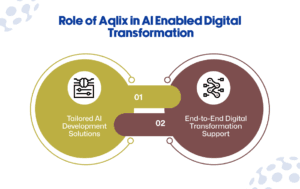
Tailored AI Development Solutions
Aqlix builds custom AI apps in response to a business issue and to improve operational services.
They are built with scalable architectures to grow as the business evolves.
Everything I build is created with performance, cost and actual ROI in mind.
End-to-End Digital Transformation Support
Aqlix supports everything from consulting and planning to developing and running the solution.
AI is integrated into cloud stacks, automation pipelines and analytics clients to form cohesive digital systems.
Continuous improvements provide lasting business value that allows the flexibility for businesses to change up strategy in response to new technology requirements.
Conclusion
AI adoption does not need to be overwhelming; small and thoughtful steps can create significant transformation. Businesses can improve efficiency, decision-making and overall customer experience by gradual democratization of AI.
Aqlix is accompanying companies on this path and aligning the development of AI to the broader context of digital transformation in a pragmatic, structured approach.
Frequently Asked Questions
What is the simplest way to get started with AI in a business?
Business can begin by recognizing small, repetitive tasks that eat up time. “It can make an organisation feel more robust and allows simple AI tools, such as chatbots or automated reports to be put into practice,” she says.
Do you need big data to do AI if you are a normal business?
It’s worth noting that with so much structured data now available, many AI tools also work well. Accuracy increases with larger datasets, but even smaller well-organized data is sufficient to start off with those small projects.
How can AI enhance customer experience?
AI personalizes interactions, enabling more rapid support and automating responses so that customers consistently receive timely engagement on all channels.
What role does AI play in digital transformation?
AI is also fundamental to digital transformation because it supplements workflow enhancement, analytics improvement, and the establishment of scalable operations throughout an entire company.
How can Aqlix assist with AI adoption?
Aqlix offers organized AI development & technology consulting, that supports organizations with effortless embedding of AI in the existing platform and making it conducive to long term digital transformation.