

Many business leaders believe that adopting AI Innovation requires heavy investment or a complete digital overhaul. That belief can make AI seem like an expensive, high-risk venture suitable only for large enterprises. In reality, AI can be a practical tool one that boosts productivity, improves accuracy, and elevates decision-making across businesses of all sizes.
At Aqlix, our mission is to help make AI tactical and approachable serving it out for all mankind. We assist organizations like the world’s leading multinational corporations and small local businesses in integrating AI into their larger Digital Transformation initiative. Our strategy focuses on incremental adoption, tangible wins, and integration into bigger themes such as Product Development or Mobile App Development.
In this article we discuss the relevance of AI today, how it influences business success, and how best to deploy it.
The Importance of AI in Today’s Businesses
AI has emerged as a fundamental driver of competition in faster markets with more data. For organizations, it has become necessary to be flexible, informed and precise in its decisions. Companies that invest in AI now can better adapt to changing customer needs and industry landscapes.
The Shifting Business Landscape
Today’s markets are more competitive than ever. Consumer preferences change quickly, innovations enter the market every day and information is generated using various sources including channel sales data, feedback from customers, operational information and online postings. In this kind of a high-velocity world, traditional cycles of decision making are far too slow.
AI allows businesses to be agile, informed and adapt as markets shift. Companies that incorporate AI as an element to their all-encompassing digital transformation will be able to outcompete, react more immediately, and adapt smarter.
The Role of AI Innovation in Achieving Business Growth
AI enhances business performance by increasing efficiency, lifting decision-making capabilities and optimising customer experiences. Its capacity for the automation of tasks, real-time analysis and optimisation resources will make it valuable in operations over the long term. Taken together, these benefits make AI an accelerant for sustainable development.
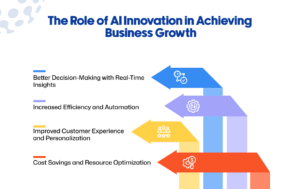
1. Increased Efficiency and Automation
AI is particularly good at automating tasks that are repetitive and time-consuming. Data entry, invoice processes, inventory management and reporting are tedious tasks that can be automated. That cuts the chance of human error and delay.
By automating away routine labor, teams are liberated to work on more strategic tasks, designing new products, providing better customer service or developing new features for a mobile app. In practice, AI is a force multiplier for human members.
2. Better Decision-Making with Real-Time Insights
Modern enterprise systems produce lakes of data, but data is not action. AI tools sift through huge data sets in seconds, extracting hidden patterns, risks and opportunities that would be impossible for humans to spot.
By making the insights such as these visible, AI supports data-driven leadership. Forecasts are more accurate, strategic plans are more grounded in fact and companies can better see shifts coming, rather than react to them.
3. Improved Customer Experience and Personalization
Consumer expectations today are high: quick response times, tailored offers, frictionless service. AI assists that by acquiring personalized recommendations, targeted marketing sales and real time customer support via chatbots or virtual assistance.
For companies that do product development or mobile app development, AI provides a way to customize experiences. Users receive more relevant content, timely suggestions and faster support. In the long run, this builds customer satisfaction and loyalty, as well as engagement.
4. Cost Savings and Resource Optimization
AI implementation can reduce labor and process costs substantially. Streamlined processes and resource allocation lead to lower operating costs. Scheduling, preventive maintenance, or demand predictions based on AI can lead to reduced inefficiencies and bottlenecks.
Additionally, it allows for improved return on investment (ROI) without the need for huge initial and ongoing spend. For many companies, small to medium size in particular, this makes AI the most cost-effective route to growth and securing your longevity.
Steps to Implement AI Successfully
Adoption of AI will only be successful if a clear goal and with an evaluation whether the process involved really lends itself to work on the basis of data occurs. Starting small with pilot projects allows for controllable risk and quantifiable results. With incremental easing and team upskilling, AI is a natural extension to everyday workloads and continuing digital evolution.
1. Assess business requirements and data readiness
Before jumping into AI adoption, it’s crucial to determine what processes make the most sense. Inspect workflows are external operations such as customer support? Internal processes like reporting? Supply-chain tasks?
And evaluate your data, too: see to it that it’s accurate and reachable. AI depends on quality data. Without good data, insights will be incorrect. “Lastly, ensure that any AI initiative is in sync with business objectives whether it’s to improve customer experience, expedite product development or enhance mobile app deployment,” she writes.
2. Start Small and Scale Gradually
A small, focused and realistic pilot project often provides greater value than a grand company rollout. Choosing a small use case makes it simpler to measure, iterate, and reduce risk.
After the pilot demonstrates promising results, broaden the use of AI across additional departments. This phased approach makes it possible to integrate AI in a meaningful way, through resources and without harming business as usual.
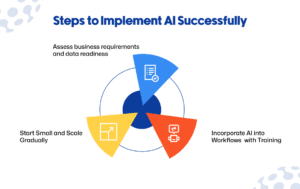
3. Incorporate AI into Workflows with Training
The best new tools are only as good as the people who use them. Very few executives are willing to upskill their team so they feel confident using AI tools. Provide training and ongoing support.
Make certain AI isn’t a brittle layer, but an ingredient in daily workflows whether it be crm in customer service or data science for product development and mobile app development. Create a work environment around innovation, experimentation and iterative learning.
Conclusion
At Aqlix, we want to make AI accessible to everyone, not just big tech or multinational organisations with huge investments. When correctly applied one that is underpinned by an incremental introduction, purposeful goals and effective training AI can become a tool that businesses of any scale have access to.
RipenApps supports companies in all stages of AI maturity from assessing the readiness to piloting/AI POC, integrating AI workflows and seeing business results that are aligned with larger organizational goals such as Digital Transformation, Product Development, Mobile App Development.
Artificial intelligence isn’t just the future of business, it’s the biggest opportunity right now for company growth. The companies that see what’s possible here, and then adjust accordingly, have a great chance of crafting their own lasting success and continued growth.
FAQ
Q: Is AI adoption a too costly matter for SMBs?
A: Not necessarily. Businesses can begin with modest pilot projects and build using available data as they incrementally gain experience and expertise with AI. Most AI-tools are scalable and many times results in more cost savings than the original tool investment with maximum resource utilization.
Q: How much time before we can expect to see the results of AI deployment such as this?
A: It is use-case dependent. Benefits like reduction in errors or faster processing can be seen in weeks for simple automation or reporting jobs. More sophisticated applications such as predictive analytics or customer personalization could take a few months of model tuning and insight integration.
Q: Do we need a massive data infrastructure before you can use AI?
A: You don’t necessarily need a massive infrastructure, but you do need good data that is accurate and pertinent and information that’s organized. Quality matters more than volume. Basic things like simple databases, structured records or customer logs can be enough to begin improvements with the help of A.I.
Q: Will AI destroy human jobs?
A: Not necessarily. Liberating human talent for strategic thinking, innovation and value-based activitiesContrary to removing humans from the process, this is all about freeing human capacity rather than constraining it. In most instances, rather than replacing humans outright, AI enhances our capabilities.
Q: What’s the AI connection to digital transformation and mobile app development?
A: AI will optimize digital transformation by automating repetitive tasks, delivering data in real time, and promoting informed insights-based decisioning. For example, in a mobile app AI can fuel smart capabilities like personal recommendations or in-app support or predictive behavior analysis that all contribute to the intelligent optimisation of apps around user demands.