

The business model has changed in the last few decades. The legacy workflow was heavily manual-focused, needing a human to actually be involved doing work like data entry or paperwork and documentation and approvals. While these systems provided some initial assistance to fundamental organizational needs, they tended to have a finite period of usefulness: as times changed the businesses became larger and more complex.
Organisations are now becoming more systems-oriented, they’re changing how they use computers and the data stored on them not just to automate repeated past work but to start making decisions based on “all the possible work we have ever done” and then learning from that situation followed by exploiting what’s been learned all over again, say two or three times. It is a major shift in how business functions and plans for its future. Now, rather than just human judgment, companies are operating on AI-infused infoware that speeds work and raises decisioning. That is, as AI and machine learning continue to evolve they are ushering in a new era of an autonomous business system.
The Manual Era: Human-Dependent Processes
Early operation management was done almost entirely by hand. Even the most straightforward procedures were conducted via spreadsheets, email chains and manual approvals. And even where they had been developed, they were slow and hard-to-scale methods.
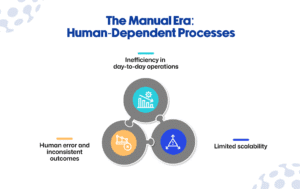
1. Inefficiency in day-to-day operations
A great deal of the organisational tasks had to be done twice and took a long time. It was difficult to do the same and maintain an even output when volume picked up. Sooner or later organizations realized this manual process was keeping them back from being able to respond in time for operational needs.
Manual processes required workers to do the same thing for hours on end, building reports, updating databases and creating customer records and so forth. They were distractions from better paid work, and hampered performance.
2. Human error and inconsistent outcomes
Mistakes occur even to veteran teams churning through piles of information. Errors can arise due to fatigue, misunderstanding by mistaken or else by other factors such as mistakes introduced doing data/ reviewing. These mixed findings hinder business decision making and create operational confusion.
Spreadsheets riddled with mistakes, misfiled documents and incorrect approvals were among the problems of manual systems. These errata were filled with corrigenda which cost us more time and effort. The inconsistent numbers also made it impossible for leaders to rely on data when making strategic decisions.
3. Limited scalability
Manual processes become more complex as organizations grow. More customers, more staff and more transactions obviously means more work so a manual process would be out of the question. Manual scaling of operations is more expensive and less efficient.
It didn’t take long for groups to figure out that adding more volunteers wasn’t sustainable. Corvaglia could also no longer afford to keep up with the relentless pace of business using superannuated industry labor, so they turned to a series of automatic- or streamlining-focused machines and processes instead.
The Semi-Automated Phase: Rule-Based Systems
Excerpt from the article:“When organizations were on prowl for optimization, it was then that we also saw an increase rule-based automation solutions like Robotic Process Automation (RPA) taking off. These machines would be capable of executing orders by written instruction and relieve man of some work.
However, this level of automation was at best process-oriented that could (and would) be automated to some extent. In the field, companies were beginning to recognize speed and accuracy benefits, but the options had their drawbacks. Rule-based systems have in fact represented a key preliminary step for more advanced AI-inspired methods.
1. Reduced burden of repetitive tasks
Software which could be run based on rules was faster than doing regular work manually. These systems also employed uniform relationships and less dependence on humans. Workers could spend more time on analytic or strategic work and less of it on rote labor.
Like automation of data, scheduled alerts or report creation based on templates. Such conditions improved efficiency in action guarantees and alleviated slow-downs associated with human contingencies.
2. Improved accuracy
Because RPA systems are rule-based, they will provide the same results each time. This works to cancel the effect of variations with regard to working habits or interpretation.
The higher outputs result in the robustness of results, and to a more automated choice. Consistency was one of the drivers for a push towards better data quality, which is in high demand with companies preparing to deploy emerging technology like AI and Machine Learning.
3. Faster processing times
Something that took hours now could be accomplished in minutes. The number of workflow “round trips” was cut, and responses to business could be turned around more quickly.
Teams had less interference from manual slow-down procedures. But rules here were still hard and fast systems. They failed to solve tasks that involved interpretation, judgment or flexibility and severely restricted their performance in complex environments.
The Age of Autonomy: Smart, Self-Learning Systems
There were no AI and Machine Learning entered into the picture Type of automation went from rule-based to intelligent rule-forming. “Systems today are able to really analyze data, learn from patterns in the data and adapt to new circumstances – and make it into a better form of itself,” Lee said.
This is an era that has evolved from automation to autonomy – where systems can respond dynamically and smartly in a never-ending changing environment. AI Development has helped systems to operate with minimal human monitoring.
1. AI-powered chatbots
Smart chatbots even know what do you intend and the context. They continue to improve with time, learning from exchanges to be more accurate and relevant. They are how businesses guarantee customers get quick, accurate replies to their questions.
Certainly these are not scripted interactions. But they still enhance your listening by comparing to old conversations and learning yourself to the new topics being of course support, and company feedback is always best.
2. Automated finance approvals
AI-driven models are examining documents, reviewing financial risks and spotting anomalies. They allow for faster decisioning because they verify information more accurately than through manual review.
That reduces lag while adding an extra degree of transparency to monetary operations. Those same tools do a number on things like invoice approvals, loan reviews and expense verifications. That means finance teams can focus more on analysis, and run less admin.
3. Intelligent mobile applications
More and more businesses are embedding AI Features into Mobile App Development. Use cases Mercantile bots: recommendation engines, voice assistants, and automated workflows.
These capabilities add to user adoption and provide situational decision support. Mobile platforms powered by AI enable businesses to provide this intuitive, structured experience even in the most complicated field environment.
The Benefits of a Self-Organizing Business Systems
Autonomy-based approaches present myriad benefits for creating change that lasts and wavelengths that are long-reaching. They can result to more efficiency, better decision-making and moreover enhanced resilience for (business) team members.
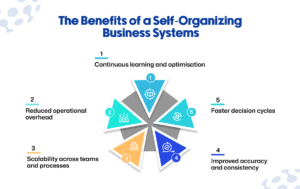
1. Continuous learning and optimisation
Rational agents adapt their behaviour in response to new information. This is a further factor that also drives them to be more meaningful at the level of task deployment.
Knowledge-based improvements may contribute to the dynamic and flexible business environment. AI-based tools refine their inputs after continuously closing a feedback loop and collecting data; the result is better output over time as tuning specific to the business increases.
2. Reduced operational overhead
The less manual intervention required, the less hours spent redoing the same task over and over again.
That now frees up groups to go do hard work that allows strategic development. It will have saved time and effort overall, more than all of any one save. By liberating staff from mundane tasks, autonomous systems unburden teams and allow companies to utilize human resources more strategically.
3. Scalability across teams and processes
Smart systems can be scaled up with increasingly amount of data without the need for a complete system overhaul.
This makes it easier to scale business units and regions. Scalable There you can sustain the performance even in bigger settings. This kind of scaling is a requirement for growing startups or companies undergoing digital transformation.
4. Faster decision cycles
Real time information can make decision making quicker. Now teams take advantage of valuable insights on the spot rather than having to wait for reports to be created manually.
This enables the response to be quicker in terms of operation, and increased swiftness with respect to customer relations. Agile decision-making also enables businesses to respond more promptly to changing market needs or internal demands.
5. Improved accuracy and consistency
Automated decisions reduce variability. So you’re getting more consistent, reliable results. Greater precision also allows better performance in challenging tasks. This there are even higher stakes in an application that if you are correct can have financial, operational, or customer implications.
Challenges and Considerations
Along with an enormous benefits that such a control from autonomus systems can provide, organizations must be aware of other responsibilities related to its use. Businesses have to get a firm handle on how their data, technology and strategy intersect.
These factors combined provide for a robust ecosystem that allows autonomy system integration to take place.
Data quality and availability
AI applications are only as good as the data behind them. Bad data in will produce bad data out. Strategies Data cleaning It helps it operates well in practice. Regular data hygiene helps Dasani ensure that its AI models are delivering insights to improve decisioning and process accuracy.
Security and privacy
Sensible informations is analyed and applied to autonomous systems. Security supports trust and compliance. Good scaffolding is a defense against data abuse. Data security policies should align with industry requirements as well as corporate standards.
Leadership and technology alignment
Only when everyone is on the same page can projects succeed. Leadership talks to tech to stay clear. The alignment makes implementation backsliding-proof. Strategic alignment ensures that AI investments serve long-range business goals.
Conclusion
The transition from manual work to these automated systems is part of a larger trend in sales. Smart tools that aid decision-making, learn from data, and improve with experience are what is needed for organizations today. It’s these second order systems of operating efficiencies that allow those folks on the team to go and do long-term value work.
Aqlix is at the forefront of enabling this transformation through AI and Machine Learning. Aqlix With deliberate design and AI development backed by the world’s technology leading corporation, Aqlix help businesses build smarter work flows which are not only more easily, but also more flexible. As firms look forward, they are building sustainable growth and resiliency through self directed machines.
Frequently Asked Questions
Well, what is an autonomous business system?
They have their own business system that’s independent and is AI & ML driven – taking decisions on its own, learning from data, automating complex work-flows without routine help from a human.
How does intelligent automation differ from rule-based automation?
Rule-based automation follows a set of rules Intelligent systems learn from experience and get better with the time.
How does AI work in predictive analytics?
Artificial Intelligence learns patterns from historical data, and with it we are able to predict success probability for future events which enable us to make smarter decisions and plan better.
How does good quality data matter to AI systems?
AI is only as smart as the clean data it’s trained on. Garbage in, garbage out.
What are some initial steps companies could take toward automated systems?
And companies can start by looking at how they do things, tidying up data practices and collaborating with smart system design experts like those you’ll find at Aqlix.