

In the rapidly changing digital era we live in today setting a business transformation in motion begins at the top with leadership that is visionary. In any transformation, leaders play the most important role in defining vision and aligning people to execute it.
Disruption deeply affecting organizations of all types and sizes All kinds of organizations are grappling with an unprecedented level of change, caused by innovation, competition and evolving market demands. With digital technologies remaking industries, leaders are now responsible to do more than preside over change — they must orchestrate transformation.
In this article we will explore the leading leadership strategies that are helping organizations traverse their paths to transformation, build agility through tech consulting and enable ever-growing until sustainability becomes a part of culture.
Understanding Business Transformation
“Transformation isn’t about a company or organization being 100 percent perfect — it’s about being able to break free from a dogma,” and reimagine the business of tomorrow, she said. It’s operational, strategic and cultural transformation that aims to make an organization more agile, efficient and customer-centric.
It may be the digitizing of core operations, or reengineering of workflows or reinventing the customer experience. But what makes change successful is effective leadership alignment — when every leader within the organization, whether in the C-suite or out on a Wild fact Medieval battlefield with his team commanding them, agrees to some common goals and commitments.
Why Leadership Alignment Matters
When there is common understanding among leaders about what the goals are, how to get there and even communication strategies going forward, organizations can find direction and stability. “You can’t have the company tell, you need to spawn it and change it organically, establish the culture,” he said. “Companies also need to listen to their employees and make them feel empowered that their ideas were not only valued, but that they could work in a supportive environment.”
We believe technology is just good when it has a strong leadership, strategic direction and clarity. Cultural leaders who create a sense of purpose are more likely to see technology investments convert into real success.
Key Leadership Strategies for Transformation Success
All organizations are different but there are Fundamentals for Leaders of Successful Change that can be applied in every organization.
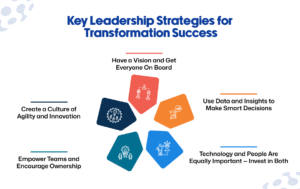
1. Have a Vision and Get Everyone on Board with It
A great story of transformation starts with a compelling vision. Leaders need to communicate where the browser is heading and why change is needed. A great vision inspires teams, aligns departments and fosters trust across the organization.
Transparent communication is equally critical. Other common stressors are uncertainty and lack of information: companies have a duty to keep their staff informed. Regular updates, open conversations and leadership visibly demonstrating commitment help employees feel reassured and in control. When people see “the light” and realise the ‘big picture’ they wholeheartedly take part in change.
2. Create a Culture of Agility and Innovation
Change flourishes in a culture that prizes agility, adaptability and innovation. Leaders who promote experimentation and learning are able to develop teams that welcome change instead of resisting it.
Infusing key tenants of agile—like cross-functional teamwork and rapid, iterative problem solving—allows businesses to pivot on the fly and cater to changing market needs.
Building such agile frameworks is possible with strategic technology consulting offered by Aqlix IT Solutions to organizations. Together they lead to transformation at speed with minimal disruption by aligning leadership and iterating through solving that will drive business.
3. Empower Teams and Encourage Ownership
Because the truth is, real transformation requires employees to feel trusted and empowered. Leadership needs to empower authority, drive accountability and foster responsibility.
An empowered team can make faster decisions, and drive innovation and yield valuable feedback from the field. The organization, when leadership emphasizes empowering rather than controlling, then becomes dynamic and self-supporting.
The culture of ownership is further underlined by regular feedback sessions, mentorship programs and open communication channels. Leaders need to acknowledge the good and celebrate small wins – the encouragement needs to come in all along a journey of transformation.
4. Use Data and Insights to Make Smart Decisions
Modern leadership requires data-driven decision-making. Intuition needs Backing From ROI, Insights and Data in a digital business Intuition is good and moral philosopher may say that it’s the mother of all knowledge, it need instincts to know where to focus your resources but like Conner suggest on his book “empower or perish”, intuition must be built on top of analytics, insights and measurable performance.
Leaders who leverage real-time data can see trends, anticipate problems and make smarter decisions more quickly. This approach allows companies to tweak strategies before disruptions falter.
Technology consultancy helps companies to set up data management and analytics that provide executive leadership with targetable business insights. As the team at Aqlix IT Solutions insists, technology is a tool for transformation and only along with human judgment and strategic perspective.
5. Technology and People are Equally Important Invest in Both
For successful transformation, it’s about that investment in technology as well as human capital. Digital tools, such as AI, cloud computing, and automation, create efficiency — but it’s people that fuel innovation and creativity.
They also have to make sure their employees are trained and prepared to work with the new technologies. Upskilling sessions, workshops and leadership programmes develop both confidence and competency at all levels within the organisation.
For example, those organizations investing in application modernization are helping them move away from legacy and outdated system and to those that are agile, scalable and enable innovation. Read more regarding it at Application Modernization Services by Aqlix.
They educate humans and technology to work well together, and promote a balance ecosystem prepared for continuous evolution.
Overcoming Leadership Challenges During Transformation
The highest quality leaders encounter turmoil during change. Resistance to change, skills gaps and ambiguous goals can slow down progress. But good headship turns them into learning solutions.
Good managers solve these through empathy or communication, but great leaders use strategy. They understand what the employees are saying, they articulate what it is we want to achieve, and they share what’s happening: And they do it all transparently.
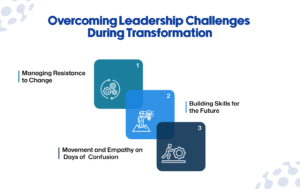
1. Managing Resistance to Change
Pushback is to be expected when old processes are disturbed. “Leaders need to help employees understand that transformation is not about trading people in, it’s about improving how work is done.”
And by engaging teams in the planning and decision-making process, leaders minimize resistance and maximize trust. Sharing success stories and tangible gains builds confidence and engagement.
2. Building Skills for the Future
Most transformations fail through lack of capability or old-school thinking. Management’s first priority should be lifelong learning and making sure opportunities exist for staff to grow along with the business.
Workshops, mentorship opportunities and technology-based training tools also help employees remain current in today’s changing digital world. Great leaders create not just a team that can adapt to change—but that shapes it.
3. Movement and Empathy on Days of Confusion
Change can always imply the unknown, particularly during structural or cultural transitions. Leaders who stay empathetic, transparent and consistent support their teams through change.
By adopting an open and continual dialogue in doing so displaying a sense of strength, leaders can build confidence and security – essential when transforming business.
Case Study: Leading Change in the Digital Age
Think about a mid-size company that has been losing efficiency as it relies on proprietary outdated systems. Company leadership knew that digital transformation was vital, but were hampered by internal resistance.
With strategic technology consulting and open communication, leadership painted a vision of better operational agility and inter-employee collaboration. The business invested in a modern cloud-based infrastructure, given their workers the right skills to be able to use it successfully and improved productivity while reducing costs in the span of one year.
It’s an example that visionary leadership with the right data and technology resources can evolve even traditional business models into nimble, future-proof businesses.
Conclusion
And it is key for business transformation, because we have to learn and change the way we operate.
Purpose-driven, people-empowering and data-guided leaders can make a difference not for just companies, but also for our world.
Here at Aqlix IT Solutions, we work with organizations to close the chasm between leadership vision and technical execution. With technology consulting and application modernization, we help businesses plan and implement transformational strategies to get measurable, long-term results.
Real transformation occurs when leadership, culture and technology converge — and Aqlix is that partner that makes it happen.
FAQs
How does leadership influence business transformation?
Leadership is the wellspring of change that presents new vision, organizes teams around it and helps them adapt the organization strategically in response new trends and technologies.
Why is it important for leadership to be aligned during transformation?
Teams without alignment lack focus and inspiration. Coordination in leadership leads to agreed messaging, cooperation and common purpose.
How does tech consulting help leaders during change?
Technology consulting offers strategic advice, guiding leaders to the right tools and smoothest implementation through to maximum ROI on digital investments.
What are typical leadership struggles in times of change?
They include resistance to change, ambiguous communication patterns, inadequate digital skills and a problem of sustaining momentum. Skilled leadership and empathy succeed in overcoming them.
How Aqlix IT Solutions help their clients accomplish business transformation?
Aqlix IT Solutions is dedicated to the success of our clients—partners in their transformation journey, and provides consulting, modernization, and support from the beginning of every project they undertake.

