


Introduction
2025 has become a touchstone for how business gets done. Today, companies have more data than ever before and knowing how to make the most of that information is a matter of life or death when it comes to business success. AI development with Aqlix is no longer a novelty or something exclusive to big business. It is now integral to the efficient, innovative and competitive relevant of every sector.
Companies who are slow to adopt AI strategy may quickly end up being left behind by the competition, who use it to offer highly customized services and drive efficient operations with no waste. The distance between AI-powered companies and those using legacy tactics is growing ever larger by the day. Going forward, it won’t be a nice-to-have to have a strong AI strategy—it will be a must in order to stay competitive in this increasingly dynamic environment.
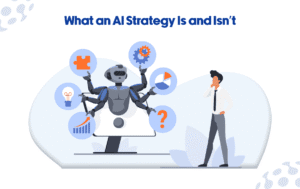
What an AI Strategy Is and Isn’t
An AI strategy is a plan for how your organization will do that and what role artificial intelligence will play in the way the company operates, makes decisions and plans its future. It’s not just about buying AI tools or software. Rather, it sets technology on the course to business and gainful results.
The point of an AI strategy is to articulate how AI will enable the organization to achieve its objectives for efficiency, customer experience, inventory management and so on. Firms such as Aqlix IT Solutions partner with businesses to ensure they carefully consider where AI can deliver real value and how to deploy it without undue complication.
Aligning Technology with Business Goals
A good AI strategy starts with what it is all about. Simply because it’s a trendy or widely adopted technology trend, projects should not throw in AI. Rather, it must be attached to real business requirements such as increasing decision accuracy, enhancing customer lifetime value (LTV) calculations, creating the most efficient workflow process possible or minimizing operational risks.
Businesses should posit outcomes that they aim to see before choosing tools.
- Data must be assessed to assess whether it is adequate, available and organized for analysis.
- Teams should know how AI will make their day-to-day jobs better.
- The organization needs to figure out what “success” will be.
- The future for AI is as a tool to amplify employee abilities, not replace them.
- A strong strategy provides a focus for AI application and delivers concrete value.
Why Small Growing Businesses Can’t Ignore AI
With markets getting more dynamic, flexibility is crucial. “The fact is, AI allows companies to react quicker, run smarter and respond to changing conditions in ways that are simply not possible (certainly not at the needed or desired speed) using manpower alone.
Rapidly expanding firms are battling resource scarcity, scalability and competition pressure. AI democratizes the playing ground by enabling smaller players to do more with less, improving decision-making and operational precision.
1. AI Enables Scalable Growth
For expanding businesses, scalability is a major problem. Processes, for instance, that are effective for a team of 10 may not be as effective with a team of 100. It enables scale and expands human potential by automating work, analysing massive data sets and helping in decision making without having to grow staff or infrastructure.
- Automation makes workflows more efficient with the help of AI.
- And it gives you intelligence to inform strategic carry.
- Thus reduced the operating cost, promoting rational using of resources.
- It drives levels of performance as the business grows.
- It avoids the bottlenecks often seen in growth.
2. Improving Customer Experience Through Personalization
Personalization and responsiveness are paramount in customer expectations today. AI studies customer behavior to aid businesses customize offerings, recommendations and communication at real time. This has the effect of building customer engagement as well as loyalty.
3. Faster Innovation and Real-Time Decision-Making
AI monitors data in real time to help find opportunities and risks. This enables organizations to make their decisions strategically, rather than reactively, leading to more durable choices in unstable environments.
Building an Effective AI Strategy
You cannot just one day make up your mind to have an AI strategy. It’s a marathon not a sprint, it continues as your business scales and the markets change.
Enterprises need to figure out where AI will have the most value and how it fits into existing systems and workflows. Effective AI plans take small steps and then scale up incrementally to provide evidence of payoff.
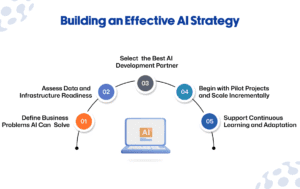
1. Define Business Problems AI Can Solve
The next, of course, is identifying what’s going wrong or could be done better. AI is also better suited to problems that are recurring, data based or analytically complex.
- Identify and then eliminate tasks that require manual labour.
- Look at where decisions feel slow or tentative.
- Identify touchpoints for the customer that can benefit from some personalization.
- Think about processes that have uneven performance.
- Identify what tasks would be enhanced with predictive agility.
2. Assess Data and Infrastructure Readiness
Low quality of data and syntheticity are the important factors in failure AI success. Final Thoughts on a Single Source of Truth Businesses need to carefully consider whether their data is reliable, available, and consolidated throughout departments.
3 Select the Best AI Development Partner
An expert partner mentors the AI solution with design integration and scaling. Aqlix IT Solutions partners with companies to integrate artificial intelligence development into business context and business strategy.
4. Begin with Pilot Projects and Scale Incrementally
Begin small to test before you scale. Pilot projects work to refine models, increase accuracy of data and help prepare teams for wider adoption.
5. Support Continuous Learning and Adaptation
AI strategies must evolve. Frequent check-ups to make sure a solution is still applicable as market conditions change and business objectives mold.
How NOT to think about AI Strategy
Yet despite the clear advantages, many organizations find it difficult to deploy AI successfully. Learning about some common pitfalls before investing can save wasted money.
Steering clear of these pitfalls means that the value is sustained, rather than it being a fleeting impact as with AI solutions. Making the right preparation and alertness are essential factors that contribute to long-lasting success.
Lack of Clear Objectives
Artificial intelligence should not be used without clear objectives or the results may become impossible to compare or defend.
Poor Data Quality
Errors in the data cause inexact predictions and unreliable analysis. First data analysis is needed before the model can be used.
Ignoring Employee Enablement
Workers must know how AI helps them do their jobs. Training and communication help lower the level of resistance and increase adoption.
Conclusion
AI is a requirement for growth in business by 2025. It provides operational excellence, enables innovation, and empowers organizations to make real-time, data-driven decisions. Companies that chart their AI course will be much more able to pivot and compete sustainably.
Aqlix IT Solutions helps companies build and implement straightforward, practical AI strategies that drive sustainable business value. Aqlix enables smarter growth for businesses in the digital age through mapping AI initiatives to business goals, data structures and operational workflows.
Frequently Asked Questions
What is the AI strategy in business?
AI strategy is a definition of how an organization will use artificial intelligence to help deliver on its business objectives or the goals for some parts of the organization such as decision making, productivity gains and customer satisfaction.
Why is AI important in 2025?
AI enables companies to process data at lightning speed, automate key workflows, innovate rapidly and respond more efficiently to dynamic shifts in the marketplace.
Does AI replace human roles?
No, AI is not a replacement but an enhancer to existent human work on data-heavy and repetitive tasks.
How should a company begin to use A.I.?
Key steps to start include setting goals, evaluating data readiness, choosing an AI partner, and starting pilots to gauge value.